The most recent issue of UMConnection, the newspaper of the Baltimore-Washington Conference of the United Methodist Church, has a great article about United Methodist participation in the immigration reform rally, including quotes from UMOnFire staff Jen Mihok, a reference to our BorderLinks trip, and a front page photo of OnFire members. Check it out:
United Methodists call for immigration reform
BY JOHN W. COLEMAN SPECIAL TO THE UMCONNECTION
Baltimore-Washington Conference churches were represented among the tens of thousands of marchers who gathered in the nation’s capital March 21 to call for improvements in U.S. immigration laws.
“The time for comprehensive immigration reform is now,” proclaimed United Methodist Bishop Minerva Carcaño of Phoenix, Ariz., leader of the Desert-Southwest Conference.
She joined a diverse procession of speakers representing religious bodies, advocacy organizations, labor unions and other groups. They urged Congress and President Barack Obama to move the issue to the top of the legislation agenda.
Churches from Washington, D.C., to Frederick, Baltimore, Hyattsville, Oxon Hill and other areas of the conference joined the colorful, enthusiastic, noisy throng of marchers, many of them shouting “Si, se puede” in Spanish and “Yes, we can” in English. Parading with signs, banners, baby strollers and even marching bands, they filled nearly five blocks on the national mall near the U.S. Capitol.
“This country says to you, ‘Harvest our fields, build our homes, take care of our children, serve our tables, clean up after us and then be gone,’” Carcaño told listeners.
She and other speakers called for humane, viable policies and procedures that would allow about 11 million immigrants now in the U.S. illegally to attain legal status and to work and live with their families, safe from intimidation, arrest and deportation.
Carcaño, who chairs two of the denomination’s immigration task forces, called current laws and enforcement “a shameful state of affairs for a country that prides itself on providing justice for all.”
Hundreds of United Methodists were seen gathered and scattered among the crowd with identifying shirts and signs. They came via trains, cars and buses, some from across our region, others from across the nation, many riding all night to be a part of history.
“We have voices and power, and we are here to say we want this to be a fair and just system that treats people with dignity and respect,” said David Hosey, who attends Dumbarton UMC in Washington. He is a mission intern with the General Board of Global Ministries.
Part of the church’s active young adult group, he and others visited both sides of the border in Nogales, Ariz., and Nogales, Mexico, last October. They met with Mexican migrant workers and high school students through the BorderLinks program. “We saw the economic disparities and pressures they suffer,” he said. “They’re looking for opportunities, jobs and hope for their families.”
Jennifer Mihok, a member of Woodside UMC in Silver Spring and a mission intern at the Methodist Federation for Social Action, coordinated the trip. “I’m here because I don’t need to be in the shadows when so many others have to be,” she said.
“This was an amazing experience and a strong statement for our country to address the need for comprehensive immigration reform” said the Rev. Edgardo Rivera, who coordinates Hispanic/Latino Ministries for the Baltimore-Washington Conference. “Offering a path to citizenship for undocumented people and protecting them from harm and exploitation is an issue of justice and hospitality. I’m pleased to see our church represented here.”
Valerie Hames, of First UMC Hyattsville, worked with others across the conference since December to promote the march and organize buses to bring in church members. “But when I finally saw all the people gathered there at the march, I was overwhelmed,” she said. “The energy there was great, and hearing victims of enforcement and broken families speak their pain — especially one little boy — really resonated with a lot of people and opened their eyes and hearts to this problem.”
Hames, who came here from Sierra Leone 20 years ago, endured her struggles with the inefficient, expensive immigration legal system before finally receiving her green card just this year.
She is a volunteer in the Justice for Our Neighbors (JFON) immigration legal assistance ministry at First Church Hyattsville, and she chairs the conference’s oversight committee for the program which operates in three locations.
“I brought JFON volunteers to the march for them to see how important this ministry is to people’s lives,” she said. “And I felt stronger about my own involvement in JFON when I left there.”
The drums playing behind us drowned out the speakers, but it didn't matter. Vitality, vibrancy just swept through the mass of activists on the mall before Congress, and we were all affirming, "Sí se puede!" There were so many people of all ages, races, nationalities, abilities, sexualities--- immigration is an issue that touches us all, whether or not we acknowledge it. And, as Christians who believe in a Christ who breaks down boundaries, we are called to speak for immigration reform.
I keep coming back to the story of Hagar. The name Hagar means The Alien--- not just alien, but The Alien. Her story is like that of so many immigrant women, forced to offer her body to her oppressors. Here, she becomes the wife of her mistress's husband, only to be used for her reproductive labor and thrown away when she and her son can be constructed as threats by her jealous, fearful mistress. That is the experience of The Alien: she is disposable even after she has labored for her oppressors, given of her own body. And then she is cast out. In the USA, our economic and immigration policies require the use, abuse, and ultimate disposal of immigrants within our country. As a Christian, I reject these policies, opting instead for comprehensive, compassionate immigration reform.
I walked with a group of beautiful people from church in Georgetown to the Mall for the march on March 21, our signs under our arms gearing up to agitate. We stopped to let some in our group get lunch, standing outside to enjoy the beautiful day. A man walked past us, read our signs and then said, "I have no problem with immigration as long as it's done legally. I have dual citizenship with Ireland and am working on my third. Legally immigrating is not that hard!" I want to point out that he did not stop walking when he said this. He continued to walk past us, denying us a space in which to dialogue with him, though my friends did try. It was another reminder of lengths at which those of us who are from privileged communities defend our ignorance. We live in a culture that fosters this ignorance, these myths and lies we tell ourselves to keep ourselves from action.
Though I have only begun the project of educating myself about immigration, I have learned that legally immigrating is indeed difficult, if not impossible. I have heard people talk about their birth countries, listened to them tell me about the beauty of their homes. Yet they had no real choice: is there a choice to be made between starvation and immigration?
One of the biggest problems in this immigration debate is that, like the man who talked at (and not to) us in the street, we do not understand our own culpability. We, those of us with privilege, tell ourselves that we just need to figure out how to help better the economy "down there" (in the Southern hemisphere) so people can stay in their homes. We forget our own culpability in this system of illegal immigration. We forget/deny how our government policies like NAFTA redirect the wealth of Mexico into the pockets of the USA and Canada. We forget/deny how we demand cheap labor. Our own policies have created this situation.
So as part of my journey to educate myself, I became an advocate for immigration reform, leading me to the march on Sunday. I stood with people of faith for immigration reform, holding signs that said "Dignity not Detention," "Reform not Raids," and "No Person is Illegal," adding my voice to the shout of "Sí se puede!" This is where I saw Christ moving: in the voices demanding that all peoples' humanity is honored.
As we walked away from the mass of people, heading back home, we passed as some people sang and danced, others rested from a long day standing in the sun under trees that had only begun to bud. But I think many of us felt energized by the presence of so many people coming together to advocate for human dignity. So the next step for us is to hold ourselves and our leaders, our faith leaders and political leaders, accountable to pass humane immigration reform that keeps families together.
"For Christ is our peace, who has made the two one and has destroyed the barrier, the dividing wall of hostility, by abolishing in Christ's flesh the law with its commandments and regulations. His purpose was to create one new person out of the two, thus making peace, and in this one body to reconcile both of them to God through the cross, by which he put to death their hostility. Christ came and preached peace to you who were far away and peace to those who were near. For through Christ we both have access to the Father by one Spirit." -- Ephesians 2: 14-18
I have a vendetta against walls.
For some reason, it has taken me months to write this. Sentences and phrases have been floating in my brain that whole time, surfacing occasionally to disturb the waters. Sometimes it takes an outside push, a rock dropped in the pond.
The other day a friend asked me, “What did you think when you went to Mexico and saw the Wall?” It wasn’t just a casual question. She knew that it wasn’t my first experience with a wall built to divide.
(Me at the Wall in Abu Dis) I lived in Jerusalem from September 2007-December 2008. If the early church considered Jerusalem to be the center of the world, I wonder what they would think of the city today, divided as it is by a massive concrete wall, some 25 feet high, studded with watchtowers and barbed wire and defiant graffiti, broken in places by checkpoints that serve as choke points on the movement and access of Palestinian civilians. In urban areas, the wall is twice as high as the Berlin Wall, and its total length stretches four times as long. Its route snakes deep in the West Bank, Palestinian territory occupied by Israel since 1967. More than 75% of its projected route is inside the West Bank, rather than on the internationally recognized border between Israel and the hoped-for Palestinian state.
(The Wall at Qalandia Checkpoint, between Jerusalem and Ramallah)
(A map of the route of the Wall in the West Bank)
The Wall divides not only Israelis from Palestinians—a problematic enough separation if there is ever to be peace in the land that is called Holy—but Palestinians from Palestinians. In the East Jerusalem neighborhood of Abu Dis, close to where I lived, it runs right up the center of the street, cutting Palestinians off from family, work places, places of worship, schools, and clinics that used to be just across the way. In villages like Bil'in, Jayyous, and Ni'lin, it cuts Palestinian farmers off from land and water resources that they have had access to for hundreds of years. A July 9, 2004 advisory ruling from the International Court of Justice declared the route of the Wall to be illegal under international humanitarian and human rights law. Palestinian communities, with the solidarity of Israeli and international human rights defenders, have worked and marched and demonstrated and struggled against the construction of the Wall. 19 Palestinians have been killed by the Israeli army during protests against the Wall. The youngest of these, Ahmed Husan Youssef Mousa, was only 10 years old. Hundreds more protestors, Israelis, Palestinians, and internationals, have been wounded. One U.S. citizen, Tristan Anderson, was shot in the face with a high velocity tear gas canister and remains hospitalized with brain damage almost a year later. If he had been Palestinian, he likely would have died—prevented from reaching necessary care because of restrictions on Palestinian movement.
(Unarmed protesters against the Wall in the village of Bil'in are violently dispersed by the Israeli military. Photo by ActiveStills, an Israeli organization)
So when our OnFire/BorderLinks group got to the border crossing in Nogales, and got our first sight of the U.S./Mexico Border Wall, it seemed an oddly familiar sight. Nogales used to be one community, straddling the border between Mexico and the United States. Now it is cut in two—separated, divided by that ugly wall.
(Photos of the Wall in Nogales, Sonora, Mexico. The crosses memorialize those who have died making the border crossing)
It sounds strange to say, but compared to the massive Apartheid Wall in Jerusalem (the Hebrew word for the wall, “Hafrada,” means separation—just like the term “Apartheid” in Afrikaans) the U.S./Mexico border wall looks a bit…dinky. Constructed largely out of scrap metal from the United States’ first foray into invading Iraq, the Wall left me with the impression that, given enough momentum, enough people, we could just push it down.
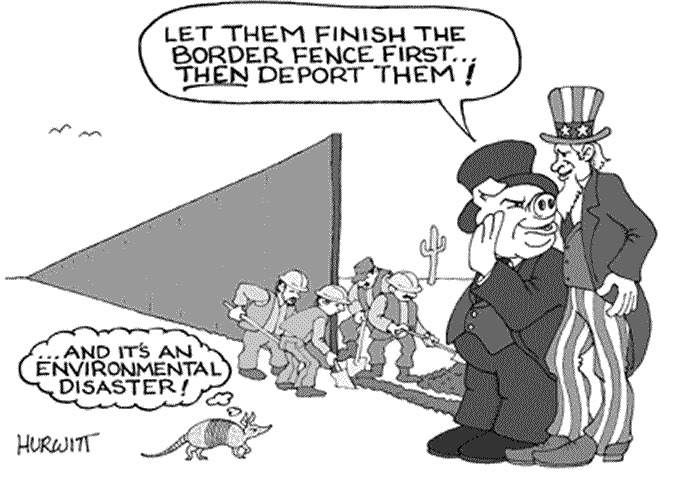
But it’s no less solid, no less insurmountable for those with the wrong passport, than any other wall that’s ever been built between people with economic resources and hands on the machinery of global power and those without. It’s no less environmentally catastrophic, interfering not only with human migration but with animal migration routes that are threatened with permanent disruption. It's no less symbolic of separation and exploitation, of our inability to live into the vision of Beloved Community offered to us by so many prophets over so many thousands of years. Our own home grown Separation Barrier is an ugly, rust colored reminder of our failure of imagination when it comes to our relationship with our neighbors to the South.
Walls across the world are remarkably, banally, similar. Walls that are built to divide are almost always built between populations “with” and populations “without.” Walls that are built to divide are never constructed by communities coming together—the only walls built in that way are shelter walls, walls of houses and community centers and places worship and education. Walls built to divide are built by governments, by corporations, by power brokers—not by grassroots communities. Not by love.
The Walls in Palestine and the U.S./Mexico Border have more in common than symbolism, though. Both are being built, in one way or another, by U.S. taxpayer dollars. The West Bank Wall is subsidized and made possible by the more than $3 billion in military aid that we pour into Israel each year, by loan guarantees and political support and UN vetoes offered without precondition. (The U.S. Army Corps of Engineers has recently begun constructing another massive Wall, this one on the border between the Gaza Strip and Egypt). There’s a direct corporate connection, as well. Elbit Systems, an Israeli company that produces surveillance and military equipment, is responsible for much of the detection equipment on the West Bank Wall and has half of the contract on the Border Wall.
Elbit, by the way, is one example of the way that people power continues to exert itself against the power of Walls. Elbit’s role in the Apartheid Wall in the West Bank has made it the target of international divestment campaigns. In response to a call from Palestinian civil society groups, human rights advocates around the world have spoken out—and acted out—against companies that profit from the ongoing conflict over and occupation of Palestinian land. The Palestinian Christian community has issued a Kairos call for churches around the world to join in these and efforts. Recently, a Norwegian government pension fund, a Danish bank, and a Danish pension fund have pulled millions of dollars in investments from Elbit because of the company's violations of international law and human rights. Divestment campaigns in the United States, including in many churches and college campuses, are targeting Elbit and creating alliances with groups working for the rights of migrants. Campaigns like these begin to expose the cracks in the seemingly monolithic Walls that divide us—cracks that we can get our fingers in, to steady us or to climb up or to pull down.
--
Walls, to me, have become so symbolic of what it is that we are struggling against, of the break down of the community we are called to, our inability to cross borders and barriers and find common ground.
What we are up against is separation—separation of so many kinds. The Dividing Walls of the world literally separate us from our neighbors, entrenching the divisions of economic or political apartheid. Our own personal struggles and alienation make us feel separated—from each other, from God’s infinite and incredible love for us.
Those of us who have taken the first stumbling steps in the prophetic walk toward justice and peace are up against separation, too. So often we get caught up in the narrow lanes of “issues” or “causes,” missing the Beloved Community created by our common struggle. There’s an organization called Jobs With Justice that asks supporters to take a pledge to show up, five times a year, for someone else’s struggle—for a cause or an issue that is not “my own.”
The only tool we have to dismantle the Walls that separate us is our collective imagination, that Spirit that invites us to create communities across dividing lines. It is exactly this collective imagination, unrestricted by borders, that we see in the Palestinian villages of Bil’in, Jayyous, and so many others, where Palestinian communities invite Israeli and international human rights defenders to join them in their nonviolent struggle against the Wall, and to take the message of justice back to their governments and to the corporations behind the construction of separation. It is this collective imagination that our OnFire group experienced when we spoke to Lupe Serrano at the Wall in Nogales, and he showed us the art that he and others have created on the Wall—something that is not allowed on the U.S. side—in a prophetic refusal to be contained. It is this collective imagination that we see as people of faith and hope join hands across borders and issues and identity groups, join hands and feet and voices in the great global uprising of people’s movements dedicated to justice, peace, and a more equitable sharing of the resources of this incredible world.
(Me with some of Lupe Serrano's art on the Wall in Nogales)
What we are up against is separation. But separation, as powerful as it is, is remarkably susceptible to the steady, patient work of the candle-lighters and the border-crossers and the Wall-defiers.
We can build very tall Walls and very long Walls and very deep Walls. The Wall that is being built on the border between the Gaza Strip and Egypt is deep enough to cut off tunnels that are the only means of commerce for the Palestinians in Gaza. The Wall that is being built on our southern border will supposedly be able to stop the wave of migration brought about by severe economic inequality. The Wall that the Israeli government builds in Palestine is supposed to be so high and so long that it will somehow be able to contain the anger of people who have been denied their freedom and their rights and their land.
But no matter how tall and how long and how deep we build these Walls, cracks begin to appear. Cracks that light can shine through. Cracks that voices can whisper through. Cracks that are big enough for our fingers, for our hands, for holding and for pulling and for climbing.
(A group of Palestinians from the village of Ni'lin pull down a section of the Wall on the 20th anniversary of the fall of the Berlin Wall in November. They are met with tear gas fired by the Israeli military)
Together, we will pull down these walls. And imagine, just imagine, what beautiful things we can build instead with the leftover reminders of our former separation.
David Hosey is a mission intern with Global Ministries of the United Methodist Church. From September 2007-December 2008 he worked with the Sabeel Ecumencial Liberation Theology Center, a Palestinian Christian organization based in Jerusalem. During that time he was blessed with the opportunity to meet, learn from, and walk alongside Palestinian Christians and Muslims, Israeli Jews, and international human rights defenders struggling for justice, peace, and reconciliation. He now lives in Washington, DC, where he serves as the National Media & Coalition Coordinator for the US Campaign to End the Israeli Occupation, a national coalition of more than 325 organizations working to change those U.S. policies toward Israel/Palestine that violate international law, human rights, and the principle of equality for all. He blogs (regularly) at the End the Occupation Blog and (more sporadically than he'd like) at City Of...
It's been a few weeks since the OnFire team returned from its trip to the US-Mexico border. There are now five blog entries posted (in November and December) with summaries and reflections from the trip.
In addition, I wanted to share some useful resources that have popped up over the past month or so. Take a look, comment and pass them on. If you're interested in writing an entry for this blog, contact umonfire@gmail.com. Thanks!
Health care: Catholic Bishop John Wester discusses the benefits of including undocumented immigrants in health care reform in this article from Politics Daily.
Border wall: PBS recently did a 12-minute segment on the US border fence. This particular piece examines the effects of the wall on private landowners in the US, detailing the "selection process" for where the fence does and does not go. It also discusses the lack of government oversight of the private companies involved in creating and building border security technology.
Family detention: Earlier this year, the OnFire blog posted a few entries on family detention, including a close look at the T. Don Hutto family detention center in Texas. Since then, the center has been modified to house only female inmates (undocumented persons), but immigrant family detention continues under the Obama Administration, highlighted in this recent article by Lily Keber.
Great immigration blog: The Immigration Impact blog is a great resource from the Immigration Policy Center. Updated daily, the blog contains brief posts on immigration policy and its effects both on a national level and in local communities. According to the website, "Immigration Impact was launched to help shape and develop a rational national conversation on immigration that shifts the terms of the debate towards achieving workable and effective comprehensive policy reform." You can subscribe to the blog and/or the Immigration Policy Center here.
It’s a cold and rainy November morning. I’m up as usual at 6:30 a.m., out the door shortly after 8:00. Overnight, a wintry chill has moved in. Though I’m dressed warmly, my un-gloved hands are numb before I’m halfway to the Metro station. I can’t very well get to my pockets as I manage an umbrella in one hand and my lunch in the other—leftovers from last night’s dinner. On this near-icy day I’ll be able to enjoy a warm midday meal of spaghetti and meatballs—comfort food, in the psychological sense. Physically, I’ll be plenty comfortable at my desk in a heated office, sitting in a cushioned swivel chair with lumbar support. Comfort food for what discomfort?
At the same moment that I’m becoming conscious of my numbing fingertips, my eyes fall upon three figures in the distance. Two, like me, are huddled under umbrellas. The one in the center has his hands in the pocket of a hooded gray jacket and is shuffling back and forth in front of the Home Depot sign. Like me, these men are halfway to work; unlike me, they don’t know where they’re going, if anywhere. Their job “security” involves waiting in a parking lot, hoping that someone will need a hand with a home improvement project they’re tackling this Veterans’ Day.
As I continue on my way to the Metro, the parable of the laborers in the vineyard comes to mind for the hundredth time since moving to this Washington, D.C. neighborhood. How I long to be able to come home on a day like today and play the role of the compassionate owner—rewarding a full day’s wages to all of those seeking work. My head tells me that such charity is unsustainable, that what needs to be addressed and dismantled are the systems of injustice that allow this 2,000-year-old parable to have contemporary relevance. It is for that very reason that I’ve been so vocal in promoting immigration reform, health care reform, and an end to wage theft. But in this moment my righteous anger falls to the wayside. My heart breaks as I sense what can only be a small fraction of their vulnerability, a feeling that echoes an experience I had two weeks earlier in a completely different world.
2,500 miles from my northeast D.C. home lies the once-sleepy town of Altar, Mexico. The mass migration occurring over the past twenty-five years has brought a whirl of activity to the area. People from throughout Central America are passing through; some are on their first journey to the United States, but for many, the trek through the desert has become all too commonplace. During our visit* to Altar, I spent the night at a small migrant shelter run by a Catholic congregation. For no cost, sojourners can get a warm supper, a place to sleep and bathe, a change of clothes if need be, and a warm breakfast for up to three nights, though extensions are granted under extenuating circumstances.
Those seeking refuge at CCAMYN (Centre Comunitario de Atención al Migrante y Necesitado, or the Attention Center for Migrants and those in Need), however, are rarely first-time travelers. Most have already been deported from the United States—some multiple times over—and know about the shelter only because it’s not their first time traveling through the region. Migrants on their first journey are more likely to seek assistance from coyotes, guides who will see them at least part of the way to the border, but who are also likely to exploit, rob, or even physically harm the migrants—who often spend nearly all, if not everything, they have on the journey. In many cases, migrants cannot afford to pay the full price of a coyote, and must agree to pay off the debt for years to come, once they’ve crossed the border.
During dinner at CCAMYN, I found myself sitting next to Juan. He couldn’t have been that much older than I am, but the thousands of miles separating our birthplaces have taken their toll. I’ve spent the past five years on the move—mostly traveling to, from and within Europe—accessing countless destinations with the click of a mouse. Juan has spent the better part of the last ten years trying repeatedly to reach my place of departure. Temporary success has been his at least a dozen times, but that night he was on the road again. He has family in the States now, and they’re there “legally.” But he cannot risk seeing his own nieces out of fear that his sister might be charged with “harboring.” His hope is to cross and lay low for a few months; maybe then he can figure out a way to spend Christmas with the only family he has.
Juan was the first to push back from the large table where about thirty of us had eaten. The inches between us became miles again, as he embarked—under the cover of darkness—on a journey I’d have no trouble making in broad daylight two days later. Neither would I have any trouble boarding a plane to fly me back across the country to our nation’s capital.
Weeks have passed since I spent a night on CCAMYN’s tile floor. Back in the office, I heat up my leftovers and recline in my chair, watching the rain. I wonder where Juan is, whether the laborers have landed a job today, when the policymakers in the buildings outside my window will respond to the widespread, highly-organized advocacy efforts surrounding immigration reform. I wonder if members of my own family, congregation, and circle of friends will be ready to hear the stories of my trip to the border without writing me off for being “partisan,” or naïve to the “complexities” surrounding the situation. But what is so complicated about the desire of parents to feed their children, of young adults to seek a better life for themselves, of people of faith to advocate for those on the margins and in the shadows?
I put down my empty dish and sink answerless into my chair. It’s not as if these questions haven’t entered into the debate before, so what is to be done? I remember the feeling that rose in my chest as I observed the day laborers that morning: the horrific heartbreak, the longing for an outpouring of compassion, the urgency for justice to be realized on earth. But a glance at my inbox tells me that I’m not the only one experiencing this urgency. Articles, reports, action alerts, prayer requests, invitations to conference calls and prayer vigils—a whole movement is at my fingertips. I push back my plate, sit up, roll in my chair, and reach for the mouse, returning to the vineyard where new laborers are always welcome.
*In late October I traveled with a 10-member OnFire team to the US-Mexico border. We participated in a 3-day border justice immersion experience through the popular education organization BorderLinks. OnFire is a network of young adults within the Methodist Federation for Social Action, a national grassroots organization that promotes social justice in and beyond the United Methodist Church.
I recently participated in a delegation with MFSA. We traveled to
Nogales, Mexico, with a border immersion program called BorderLinks.
Glancing over the schedule, I noticed our first stop was a two-hour visit with high school students in Nogales, Sonora (Mexico). This brief visit seemed to pale in comparison to visiting a migrant
shelter, conversing with migrants at the shelter or seeing the wall that divides Mexico and the U.S. I was skeptical about how valuable it would be to spend two hours conversing with local high school students. Reflecting on the trip, however, the time spent with the high school students was the highlight of my experience.
Our delegation of nine split into eight groups with two or three Mexican high school students in each group. The groups were given some markers and a large sheet of paper. We were asked to sketch our response to three questions: (1) what are the root causes of migration (2) what are the effects of migration and (3) what can be done to improve the current situation. I was shocked at how articulately the students responded to the questions. As we began to discuss the questions, I realized that I had so much to learn from the students.
The lives of these sixteen and seventeen year old students represent the reality of a border town. They are witnesses to death as a result
of migration. They are witnesses of the wall. They are witnesses of families divided by the border. They are witnesses of death as a result of narcotrafficking. They are witnesses of border violence. The lives of these sixteen and seventeen year old students represent the reality of a border town—and we have much to learn about this reality.

 “We have voices and power, and we are here to say we want this to be a fair and just system that treats people with dignity and respect,” said David Hosey, who attends Dumbarton UMC in Washington. He is a mission intern with the General Board of Global Ministries.
 Hames, who came here from Sierra Leone 20 years ago, endured her struggles with the inefficient, expensive immigration legal system before finally receiving her green card just this year.