Pages

Wednesday, January 19, 2011

Educating to Counter Oppression

Greetings OnFire members! Planning on joining us in singing a new song? Here is an awesome opportunity for young people:

Young People's All Day Forum: Educating to Counter Oppression
Thursday, August 25, 2011, from 9:00 a.m. to 3:00 p.m.

Young People ages 18-35! Join OnFire and MOSAIC for a day of education and action. We'll be exploring methods of resistance, helping us to become better organizers and activists in our own communities. We'll worship together, and in the afternoon we'll start planning action for General Conference. If you're a young adult in the UMC and you want to work for change, you don't want to miss this!


Look for more information coming soon, and check out the Sing a New Song website and facebook page for more information on All Day Forums!

Monday, November 29, 2010

My Day at the UN, or how I didn't solve the world's problems but still learned a lot.

by Janessa Chastain
Crossposted at The Church Mouse.

Today, November 29, is the International Day of Solidarity with the Palestinian People.It marks the day in 1947 when the General Assembly adopted the resolution partitioning then-mandated Palestine into two States, one Jewish and one Arab. Unfortunately, that hasn't happened and that area has been marred by constant violence. There is a lot more to all of this, of course, and I encourage all of you to research and really study the conflicts of this area. It has become a battle, both political and holy, over land and holy ground and the sovereignty of people. The Methodist Federation for Social Action supports the establishment of Palestine as an independent state in the hope that it would bring an end to the violence in Palestine and Israel. Again, nothing is that simple, but what is clear is that peace is desperately needed.

Dr. David Graybeal, a Drew professor, along with the MFSA, invited Drew students to come participate in this day. We all loaded up on the bus at 7:45 and headed into New York City. We walked past all the flags of all the nations represented at the U.N. and made our way through security, and then into a conference room. It was set up like mini version of the general assembly - all the delegates had seats assigned and there was an open area in the back. We wore headsets to listen to the translators and the Committee on the Exercise of the Inalienable Rights of the Palestinian People began the Special Meeting.

I don't mean to skim all of the details, because it was all really interesting, but I thought I'd just highlight a few things. Many people spoke in support of Palestine from all over the world. Africa, UK, and the Middle East were all represented. The American representative didn't attend the session, I've been told we never do. Riyad Mansour spoke on behalf of Palestine. He have a powerful speech calling for an end to the violence and the settlement expansions. I loved one quote of his, "our hand is still able to carry the olive branch from the rubble." If this is true, if the olive branch can truly be offered, it is a sign of great hope. Archbishop Tutu has spoken on Palestine, comparing their struggle to South Africa's. He said in MFSA's January 2008 edition of Social Questions Bulletin (now The Progressive Voice) that there isn't reason for optimism, because that requires visible action towards change, but there is reason for hope:

"Indeed, because of what I experienced in South Africa, I harbor a vast, unreasoning hope for Israel and the Palestinian territories. South Africans, after all, had no reason to suppose that the evil system and the cycles of violence that were sapping the soul of our nation would ever change...But we have seen it. We are living now in the day we longed for...I have seen it and heard it, and so to this truth, too, I am compelled to testify - if it can happen in South Africa, it can happen with the Israelis and Palestinians. There is not much reason to be optimistic, but there is every reason to hope.

Judith LeBlanc a member of the National Steering Committee of the US Campaign to End the Israeli Occupation spoke on behalf of all the civil society organizations. She talked about the divided American opinions, the impact that divestment has made, and the need for a continued push on American law makers to bring an end to Israeli occupation.

After the speeches, we had the opportunity to see Ashtar Theater's The Gaza Monologues. Written by kids in the wake of the Gaza attacks in December 2008-January 2009, these monologues reflected the thoughts, hopes, fears of students at the time. They were were performed by an amazing group of kids from all over the world. The incorporated dance and song into the reading of the monologues, and it was an incredibly powerful experience. It is vitally important to keep a human face on the violence, to be constantly reminded of the devastating impact of inaction.

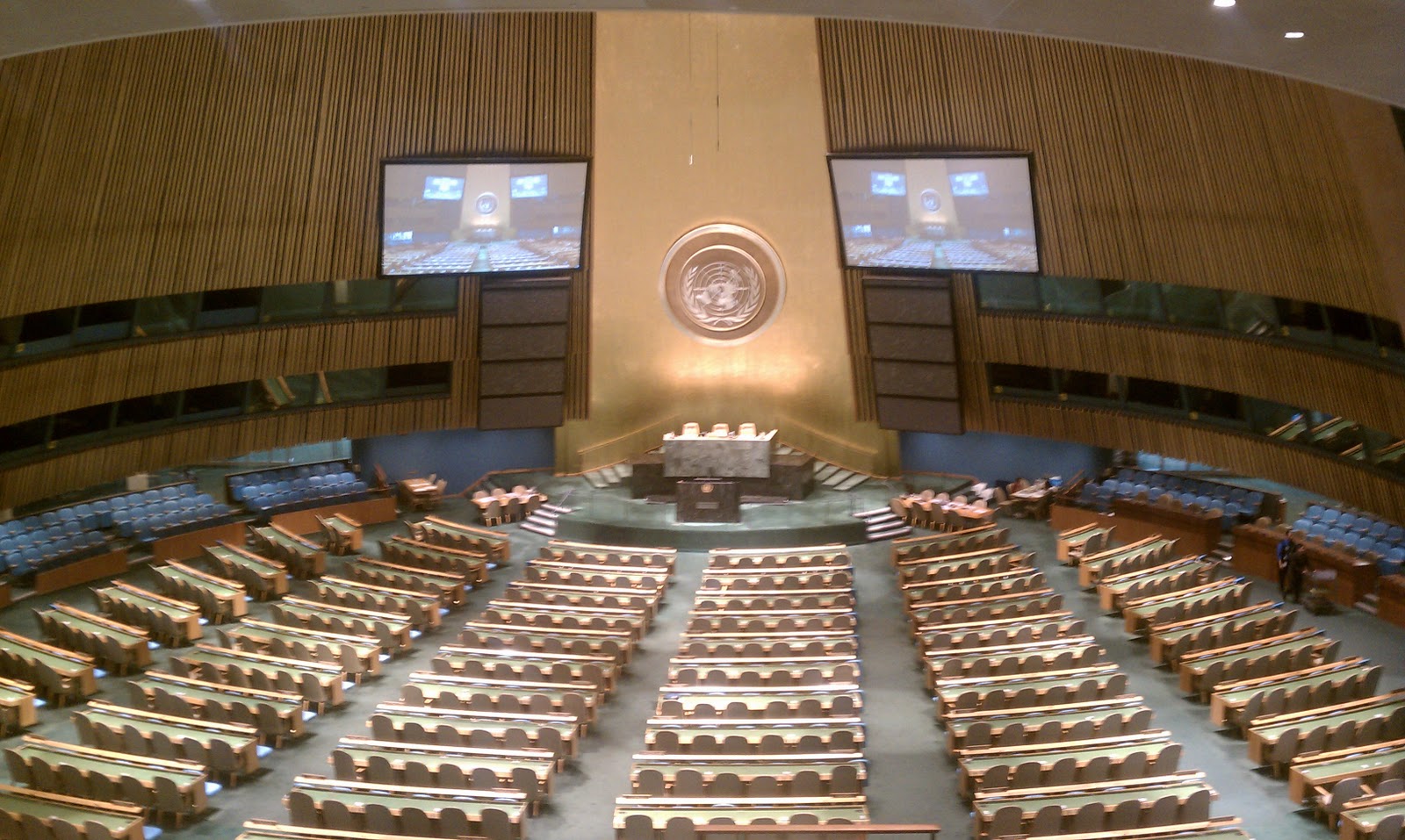
In the afternoon, we gathered up on the balcony for the General Session. It was a little breathtaking to look down on the meeting area and realize that magnitude of the decisions that are made in that space.


The speeches continued, we had to leave before the session was over, but the message was the same. The attacks on the Palestinian people had to be stopped. The U.N. was taking action, that was constantly acknowledged, as was the support of President Obama, but it was made clear that it wasn't enough. Israeli expansion needed to stop, the apartheid wall needed to come down, and Palestine needed to be recognized as an independent state.

I didn't walk away from the day with a clear idea of how to fix the problems, obviously. I realize the issues are not simple and cannot be reduced to a good side and a bad side. But I did come away with a renewed commitment to working towards peace and the reconciliation that must follow the atrocities that war brings. I don't need to go in as a Christian with "Christian agenda", but I do need to follow Christ's call to be a peacemaker. Being a peacemaker is not a passive activity. It's more than saying "violence is bad." It's pulling your investments from any company that supports violence or the machines of war in Israel. It's talking in church and to your political leaders about the need to recognize Palestine as a political state. Or it's disagreeing with that completely, but still talking and learning and saying loudly and clearly that no matter what side you're on, the violence and destruction has to stop. I don't know what my specific call to this issue is, but I know I'm being called. I'm terrified of and excited for what that might mean.

I was thinking of the Palestine/Israel conflict when we read an article in Bib Lit last week that discussed the overlooked story of the Canaanites from a Native American perspective. We celebrate the deliverance of God's people to the Holy Land, but we don't talk about what happened to the people that were already there. Where is their justice? I don't believe that any one people have a claim on God's promise and love. This is a war being fought by politicians and religious leaders, all claiming that God is on their side. We need to pray, and act, to show that God is in the peace that must come.

Janessa Chastain is a first year M.Div at Drew and a transfer student from the Northwest House of Theological Studies. You can find her blog at The Church Mouse.

Monday, November 22, 2010

My Brother's Keeper: People of Faith Confront Hate Crimes

On November 20, 150 people gathered at Grace United Methodist Church, 125 W 104th Street, New York City, for a hate crimes symposium to confront what it means and what it would look like to commit ourselves to the work of ending hate violence. The symposium, called My Brother's Keeper: People of faith confront hate crimes, was sponsored by the Conference Board of Church and Society, the NYAC Immigration Task Force, the NY chapter of the Methodist Federation for Social Action, Methodists in New Directions, the Conference Commission on Race and Religion and the Conference Committee on the Status and Role of Women. The following are reflections on this event.

My Brother's Keeper by Shannon Sullivan

The symposium was so beautifully woven together with lecture, worship, discussion, and art. We began with worship, opening with a song whose lyrics were "I am not forgotten; God knows my name"--- a powerful reminder of that communion of saints for whom we gathered today to stand up against the violence that makes people "forgotten."

For there are indeed so many who are pushed into forgotten-ness. Dr. J. Terry Todd, Drew professor and member of the keynote panel "How is the Hate Sponsored in Church and Society? How is the Hate Countered?" along with doctoral biblical studies student Rosario Quinones and civil rights lawyer Fred Brewington moderated by Dr. Traci West, spoke about the three periods of anti-immigrant fervor in the USA, weaving political cartoons from the 1880s with pictures from Tea Party rallies to reveal how the same rhetoric gets repeated again and again. And though he began by focusing on immigration, he reminded us that it is not coincidental that the rise of the Klu Klux Klan coincided with the period of anti-immigrant fervor from 1880-1924.

He ended his part of the lecture with the 1972 adoption of what has become known as the United Methodist Church's incompatibility clause: "homosexuality is incompatible with Christian teaching." Originally, the Committee on Christian Social Concerns wrote a sentence to declare acceptance of people of all sexual identities, recognizing everyone's sacred worth, but on the floor the language was changed to "incompatible." Fred Brewington said during his part of the panel that the incompatibility clause turns the bible into a weapon. And that, we began to see, is hate speech.

The day really centered around showing us of the intersectionality of anti-immigrant, racially-based, and homophobic hate crimes, as you can see from the keynote panel. The literature also reminded us about those hate crimes against Muslims in the city this year, though it was not covered as much throughout the day. There was a theatrical performance brought to us by the Teatro Experimental Yerbabruja out of Long Island, that spoke to us of the real-life events of the murder of Marcelo Lucero, thus documenting how hate crimes happen. Here, we kept hearing the words so prevalent today in our own anti-immigrant fervor: "It's not about race, it's about rule of law." And we kept seeing the bodies of immigrants broken and bruised alongside these words, proving how empty those words really are.

The blood of those impacted by the hate is, like Abel's, crying out from the ground. We must move, as we prayed at the end of the symposium, to compassion, action, and justice to repent from this sin of fear.

You can Read the full reflection here at You'll Never Guess What the Heathens Did Today

Becoming More Fully You by Kristi Soutar

Then it was back to the sanctuary for a performance of "What Killed Marcelo Lucero?", a play written by a Long Islander about this hate crime against a Hispanic immigrant which resulted in the man's death in 2008. It was a very powerful play. I was particularly struck at the end when the cast members walked through the sanctuary with the coffin, which had painted upon it not just the American or Ecuadorian flag but flags from all different nations. I found myself wondering exactly how many immigrants from each of those countries had suffered hate crimes and abuse in our country. It was a very sobering moment.

...

So here I share with you something that I was pondering during this event. Some background here is that I have already been pondering exactly what is God's nature, who does God accept into the family, and what are the conditions, if any?

I wrote in my journal that day "How do we understand God? Is God this one that has been constructed throughout history? Or is God beyond this understanding and actually open, accepting AS YOU ARE, and God's goal is making you more fully you rather than more fully what the church says you should be? I mean, who decides what it looks like to become "more like God"? Isn't the picture we've been taught one that is in line with a mainline, patriarchal, white understanding of who God is and what God desires?"

I think the part that I want others to take with them and ruminate upon is the part that I want to continue to consider: what if God's goal for us is not for us to become more like this static idea of a "good Christian" but for us to become more fully ourselves? Who constructs the picture of "good Christian"? Do we truly believe that this idea of "good Christian" is constructed by God? I'm not convinced of this. I see a history of the church, especially in America, pushing people to become normalized into the mainstream culture of Christianity. Throughout our history, we see the church telling people how they have to look and act and think in order to be accepted. I'm not sure God cares about these things as much as the church does. What would it look like if we simply sought God and strove to be more fully the people we actually are? What if, instead of seeking to be more like the church wants us to be, we strive to understand who God has created us to be and strive toward that fully realized self? If we can understand God as not only accepting us as we are but also desiring to make us better and more fully functioning versions of ourselves, maybe we can open the church doors a little wider to let in those unlike us. If we can believe that God creates diversity (of thought, appearance, and lifestyle) and wants that diversity to become more fully realized, maybe we can let those who differ from our own idea of God into the family. If we can understand God in this way, perhaps at the very least we can open our ears to hear what someone with whom we disagree thinks.

I have to admit, I rather like this idea of God over the one in which I am expected to conform to a certain set of standards and appearances that may or may not fit the person I actually am. I have trouble with the idea that God created me the way I am simply to make me different. I know some of you will say to me, "The old is gone, the new is come!" (II Corinthians 5:17), and I'm not particularly throwing this verse out. I know many of us feel that we are better now than we were before coming to faith in God. What I'm saying is that sometimes we are told we have to change fundamental parts of the person we are deep inside in order to become real and good Christians. Maybe, in fact, God wants to tune and hone those fundamental parts of ourselves and more fully integrate them into our personhood, making them useful, even integral, to our lives in Christ. I think that "the old" here refers to destructive ways that damage the person God created us to be. "The new," on the other hand, would be a version of ourselves that is fully who we are, able to fly with the wings we've had inside us all along.

You can read the full reflection here at Musings and Ramblings

To educate yourself more about hate crimes and what people of faith need to be doing to confront them, visit the Center for Preventing Hate and join the conversation on the My Brother's Keeper Facebook page.

Kristi Soutar is an MDiv student at Drew Theological School. You can follow her blog at Musings and Ramblings. Shannon Sullivan is also an MDiv student at Drew. She blogs at You'll Never Guess What the Heathens Did Today.

Thursday, November 4, 2010

Join us in Singing a New Song!

Greetings OnFire members! I am writing to you today to inform you of an exciting opportunity in 2011 to join with hundreds of United Methodists committed to organizing for justice as we approach General Conference 2012. Methodist Federation for Social Action (MFSA) and Reconciling Ministries Network (RMN) are coming together to Sing a New Song, to worship together, in worship designed by Mark Miller and Tanya Bennett, and organize for justice in our church and world.

Sing! Sing a new song!
Sing of that great day when all will be one!
God will reign
and we'll walk with each other as sisters and brothers united in love!


Save the Date!

August 24-28, 2011
Sawmill Creek Resort
400 Sawmill Creek Drive West
Huron, OH 44839


Not convinced that you need to be there? Then check out the MFSA Love Train!


Join us in August! For more information visit the Sing a New Song! website and look for more information from us soon!

We are called to act with justice.
We are called to love tenderly.
We are called to serve one another, to walk humbly with God.


*MFSA is still looking for volunteers to join its planning committee, especially those from Ohio and the North Central Jurisdiction. Also needed are individuals with experience or interest in outreach, fundraising, and workshop coordination. For more information or to volunteer, contact MFSA Board member Melissa Calvillo.

Monday, September 20, 2010

Unity Walk: Building Peace By Serving Each Other

by Ace Parsi

This weekend I experienced something pretty wonderful: a broken narrative. The narrative the last few months has been one of religious conflict between Christianity and Judaism against Islam. The conflict could be seen as Glenn Beck drew thousands of Christians to action while ignoring Matthew 25 and really the rest of the Bible which call for justice for the poor. It could be seen at a time when the notion of an Islamic center in the neighborhood of the World Trade Center brings such national anger and a leader of a church could actually call for burning the Muslim holy book. It could be seen as relationships between Israel and Palestine as projected by the media seem to harden.

Similarly, those of us who believe in religious pluralism and loving our neighbor as ourselves face tests to our faith. Uncertainty has been frowned upon. We can’t express doubt that we may not have the exact answer in our faiths and that maybe each faith is expressing part of the truth. Too often it seems like our authentic religions are being hijacked. It is projected as unnatural to walk together with fellow brothers and sisters of other faiths to fulfill the promise all our holy prophets call us to: bringing justice, love, and peace to a broken world.

So, as you can imagine events like this Sunday’s Unity Walk take an added significance. In this time of conflict, this year’s theme, Building Peace By Serving Each Other, seemed all the more appropriate. The event began at the Sikh Temple where speakers across religions took the stage to affirm that walking together did not contradict their faith—it manifested it. We ate delicious Indian food prepared by the organizers and after getting our fill, we set off for an hour of open houses in places of worship across the city. Different houses of worship opened their doors in a spirit of inclusion and unity. People were not turned away, they were not judged, and their relatively small differences were not magnified to eclipse all they had in common. When we reached the end location at the DC Islamic Center, Christians took their shoes off and women borrowed hijabs to see what it was like to go into a mosque. It was really beautiful. What made the event more special was the presence of youth. Youth organized interfaith service activities all day and expressed their commitment to acting out their faiths together.

As I expressed at the beginning of this post, there’s so much out there today to convey that our hope is being held hostage. Amidst all we see on TV and read in the newspapers, it’s hard to not think that events like this seem like drops in an otherwise intolerant and broken down pour. But as cheesey as it might seem, the event this weekend gave me so much hope. It may not reclaim a national narrative, but it highlighted the truth of unity can still rise in this environment. As William Cullen Bryant famously wrote,

Truth, crushed to earth, shall rise again;
The eternal years of God are hers;
But Error, wounded, writhes in pain,
And dies among his worshipers.


I am hopeful that continued small actions like this can continue to build on each other, bring us together, and help us each achieve what we could not do alone: do justice, love kindness, and walk humbly with our God.


Ace Parsi is a progressive Christian and education advocate in Washington DC.

Tuesday, September 7, 2010

Global Young People's Convocation and Legislative Assembly Reflection


by R. Warren Gill III

I just got finished attending the United Methodist Global Young People's Convocation and Legislative Assembly in Berlin, Germany.


Because of the diversity that God has gifted us with in our time, after the GYPC voted in a very hurtful way, I was able to sit in a circle of wounded youth and young-adults from a world-wide connection as we reflected about what had happened that evening. There was pain in that circle. But there was also love and caring in that circle. This was a gift.


There was pain in the circle because earlier in the evening, the delegates gathered decided to uphold the United Methodist Church's homophobic stance on the marriage of lesbians and gays by our clergy and in our churches. The debate was not civil. One delegate implied that those of us inspired by the Holy Spirit to work for inclusion were not a part of the Body of Christ. Another called LGBT people aberrations. But the delegates also heard words of hope. They heard that God's love is every expansive. They heard that God loves queer people.


As we gathered the following day, the conversation took a much more civil tone, and supported the Majority Report of the 2008 General Conference by the legislative committee, Church and Society II. This report was not heard at General Conference and included some very supportive gems. It also reflects the actual disagreement that can easily be found in our Church.


Diversity in the church is good. Not only diversity in the ways we look, not only diversity in the way we talk, not only diversity the clothes that we wear. But because when we come from different places, we see the many different ways that God is working which shows the greatness of God.


If we believe as United Methodists that Wesley's quadrilateral is important, we simply must remember that in the Christian Church there is a tradition of difference.


The earliest of formalized Christian Creed, The Nicene Creed, is written to resolve conflict in the church, and has had limited success in the last 1700 years since it was written. At that time, there was only one word that could be decided on, and that word was open to multiple interpretations, and theological debates continue today.


The earliest church in Rome worshiped differently than the ones in Alexandria. We also hear from Egeria, a Spanish woman who traveled to Jerusalem, that the Easter Celebration she experienced there was significantly different from her homeland.


Diversity in the church has always been there. It is good.


God has called it good.


The Council of Jerusalem as we find in the book of Acts. The question was then about Circumcision. The question was must you be like me to be like Christ? And the answer from God over and over again was no. In Ephesians 2 and in Galatians 4, the answer again was no. Over and over again through scripture and tradition, God has told us that diversity is good. You do not need to be like me to be like Christ.


Our unity as the Church is made in our relationship to Christ. As we find in John 3:16, it is through our confession of Jesus that makes us united. Nothing else. Not our uniformity of thought. Unity and Uniformity are not the same.


Our tradition is a tradition of difference. Our scripture is a scripture of difference.

The diversity of opinion in the church today about God's queer people, is just one more way in which God has granted us the good gift of diversity.


And it has been a good gift.


In a city that was once divided, both physically and metaphorically by a wall, we are reminded that no matter how high the wall, and no matter how thick, it can come down. We must work for this change, and with the help of God, no amount of concrete can stand. As I toured a section of the Berlin Wall, someone had written on it, “The people who are crazy enough to think they can change the world, are the ones who do.” Let us pray that God makes us crazy enough to make change happen in the Church. Amen.


R. Warren Gill III lives in Berkeley and is a third year MDiv/MA student at the Pacific School of Religion. Warren is a long time member of the MOSAIC Leadership, and has served on the Board of Directors of RMN. Warren attended The Global Young People's Convocation and Legislative Assembly as a voting delegate from the Western Jurisdiction.