Pages

Wednesday, January 27, 2010

What we are up against is separation

"For Christ is our peace, who has made the two one and has destroyed the barrier, the dividing wall of hostility, by abolishing in Christ's flesh the law with its commandments and regulations. His purpose was to create one new person out of the two, thus making peace, and in this one body to reconcile both of them to God through the cross, by which he put to death their hostility. Christ came and preached peace to you who were far away and peace to those who were near. For through Christ we both have access to the Father by one Spirit." -- Ephesians 2: 14-18


I have a vendetta against walls.

For some reason, it has taken me months to write this. Sentences and phrases have been floating in my brain that whole time, surfacing occasionally to disturb the waters. Sometimes it takes an outside push, a rock dropped in the pond.

The other day a friend asked me, “What did you think when you went to Mexico and saw the Wall?” It wasn’t just a casual question. She knew that it wasn’t my first experience with a wall built to divide.

(Me at the Wall in Abu Dis)
I lived in Jerusalem from September 2007-December 2008. If the early church considered Jerusalem to be the center of the world, I wonder what they would think of the city today, divided as it is by a massive concrete wall, some 25 feet high, studded with watchtowers and barbed wire and defiant graffiti, broken in places by checkpoints that serve as choke points on the movement and access of Palestinian civilians. In urban areas, the wall is twice as high as the Berlin Wall, and its total length stretches four times as long. Its route snakes deep in the West Bank, Palestinian territory occupied by Israel since 1967. More than 75% of its projected route is inside the West Bank, rather than on the internationally recognized border between Israel and the hoped-for Palestinian state.


(The Wall at Qalandia Checkpoint, between Jerusalem and Ramallah)


(A map of the route of the Wall in the West Bank)

The Wall divides not only Israelis from Palestinians—a problematic enough separation if there is ever to be peace in the land that is called Holy—but Palestinians from Palestinians. In the East Jerusalem neighborhood of Abu Dis, close to where I lived, it runs right up the center of the street, cutting Palestinians off from family, work places, places of worship, schools, and clinics that used to be just across the way. In villages like Bil'in, Jayyous, and Ni'lin, it cuts Palestinian farmers off from land and water resources that they have had access to for hundreds of years. A July 9, 2004 advisory ruling from the International Court of Justice declared the route of the Wall to be illegal under international humanitarian and human rights law. Palestinian communities, with the solidarity of Israeli and international human rights defenders, have worked and marched and demonstrated and struggled against the construction of the Wall. 19 Palestinians have been killed by the Israeli army during protests against the Wall. The youngest of these, Ahmed Husan Youssef Mousa, was only 10 years old. Hundreds more protestors, Israelis, Palestinians, and internationals, have been wounded. One U.S. citizen, Tristan Anderson, was shot in the face with a high velocity tear gas canister and remains hospitalized with brain damage almost a year later. If he had been Palestinian, he likely would have died—prevented from reaching necessary care because of restrictions on Palestinian movement.


(Unarmed protesters against the Wall in the village of Bil'in are violently dispersed by the Israeli military. Photo by ActiveStills, an Israeli organization)

So when our OnFire/BorderLinks group got to the border crossing in Nogales, and got our first sight of the U.S./Mexico Border Wall, it seemed an oddly familiar sight. Nogales used to be one community, straddling the border between Mexico and the United States. Now it is cut in two—separated, divided by that ugly wall.


(Photos of the Wall in Nogales, Sonora, Mexico. The crosses memorialize those who have died making the border crossing)

It sounds strange to say, but compared to the massive Apartheid Wall in Jerusalem (the Hebrew word for the wall, “Hafrada,” means separation—just like the term “Apartheid” in Afrikaans) the U.S./Mexico border wall looks a bit…dinky. Constructed largely out of scrap metal from the United States’ first foray into invading Iraq, the Wall left me with the impression that, given enough momentum, enough people, we could just push it down.

But it’s no less solid, no less insurmountable for those with the wrong passport, than any other wall that’s ever been built between people with economic resources and hands on the machinery of global power and those without. It’s no less environmentally catastrophic, interfering not only with human migration but with animal migration routes that are threatened with permanent disruption. It's no less symbolic of separation and exploitation, of our inability to live into the vision of Beloved Community offered to us by so many prophets over so many thousands of years. Our own home grown Separation Barrier is an ugly, rust colored reminder of our failure of imagination when it comes to our relationship with our neighbors to the South.
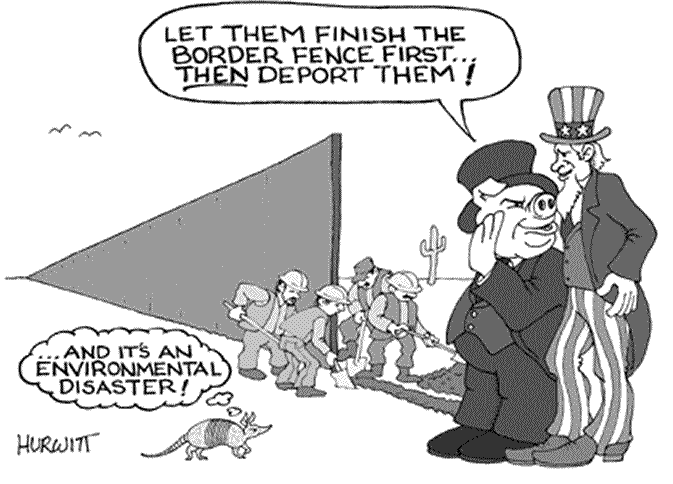

(A political cartoon from BlackCommentator.com lampoons the hypocrisy of our Border Wall)

--

Walls across the world are remarkably, banally, similar. Walls that are built to divide are almost always built between populations “with” and populations “without.” Walls that are built to divide are never constructed by communities coming together—the only walls built in that way are shelter walls, walls of houses and community centers and places worship and education. Walls built to divide are built by governments, by corporations, by power brokers—not by grassroots communities. Not by love.


(A map of our Walled World)

The Walls in Palestine and the U.S./Mexico Border have more in common than symbolism, though. Both are being built, in one way or another, by U.S. taxpayer dollars. The West Bank Wall is subsidized and made possible by the more than $3 billion in military aid that we pour into Israel each year, by loan guarantees and political support and UN vetoes offered without precondition. (The U.S. Army Corps of Engineers has recently begun constructing another massive Wall, this one on the border between the Gaza Strip and Egypt). There’s a direct corporate connection, as well. Elbit Systems, an Israeli company that produces surveillance and military equipment, is responsible for much of the detection equipment on the West Bank Wall and has half of the contract on the Border Wall.

Elbit, by the way, is one example of the way that people power continues to exert itself against the power of Walls. Elbit’s role in the Apartheid Wall in the West Bank has made it the target of international divestment campaigns. In response to a call from Palestinian civil society groups, human rights advocates around the world have spoken out—and acted out—against companies that profit from the ongoing conflict over and occupation of Palestinian land. The Palestinian Christian community has issued a Kairos call for churches around the world to join in these and efforts. Recently, a Norwegian government pension fund, a Danish bank, and a Danish pension fund have pulled millions of dollars in investments from Elbit because of the company's violations of international law and human rights. Divestment campaigns in the United States, including in many churches and college campuses, are targeting Elbit and creating alliances with groups working for the rights of migrants. Campaigns like these begin to expose the cracks in the seemingly monolithic Walls that divide us—cracks that we can get our fingers in, to steady us or to climb up or to pull down.

--

Walls, to me, have become so symbolic of what it is that we are struggling against, of the break down of the community we are called to, our inability to cross borders and barriers and find common ground.

What we are up against is separation—separation of so many kinds. The Dividing Walls of the world literally separate us from our neighbors, entrenching the divisions of economic or political apartheid. Our own personal struggles and alienation make us feel separated—from each other, from God’s infinite and incredible love for us.

Those of us who have taken the first stumbling steps in the prophetic walk toward justice and peace are up against separation, too. So often we get caught up in the narrow lanes of “issues” or “causes,” missing the Beloved Community created by our common struggle. There’s an organization called Jobs With Justice that asks supporters to take a pledge to show up, five times a year, for someone else’s struggle—for a cause or an issue that is not “my own.”

The only tool we have to dismantle the Walls that separate us is our collective imagination, that Spirit that invites us to create communities across dividing lines. It is exactly this collective imagination, unrestricted by borders, that we see in the Palestinian villages of Bil’in, Jayyous, and so many others, where Palestinian communities invite Israeli and international human rights defenders to join them in their nonviolent struggle against the Wall, and to take the message of justice back to their governments and to the corporations behind the construction of separation. It is this collective imagination that our OnFire group experienced when we spoke to Lupe Serrano at the Wall in Nogales, and he showed us the art that he and others have created on the Wall—something that is not allowed on the U.S. side—in a prophetic refusal to be contained. It is this collective imagination that we see as people of faith and hope join hands across borders and issues and identity groups, join hands and feet and voices in the great global uprising of people’s movements dedicated to justice, peace, and a more equitable sharing of the resources of this incredible world.


(Me with some of Lupe Serrano's art on the Wall in Nogales)

What we are up against is separation. But separation, as powerful as it is, is remarkably susceptible to the steady, patient work of the candle-lighters and the border-crossers and the Wall-defiers.

We can build very tall Walls and very long Walls and very deep Walls. The Wall that is being built on the border between the Gaza Strip and Egypt is deep enough to cut off tunnels that are the only means of commerce for the Palestinians in Gaza. The Wall that is being built on our southern border will supposedly be able to stop the wave of migration brought about by severe economic inequality. The Wall that the Israeli government builds in Palestine is supposed to be so high and so long that it will somehow be able to contain the anger of people who have been denied their freedom and their rights and their land.

But no matter how tall and how long and how deep we build these Walls, cracks begin to appear. Cracks that light can shine through. Cracks that voices can whisper through. Cracks that are big enough for our fingers, for our hands, for holding and for pulling and for climbing.


(A group of Palestinians from the village of Ni'lin pull down a section of the Wall on the 20th anniversary of the fall of the Berlin Wall in November. They are met with tear gas fired by the Israeli military)

Together, we will pull down these walls. And imagine, just imagine, what beautiful things we can build instead with the leftover reminders of our former separation.


David Hosey is a mission intern with Global Ministries of the United Methodist Church. From September 2007-December 2008 he worked with the Sabeel Ecumencial Liberation Theology Center, a Palestinian Christian organization based in Jerusalem. During that time he was blessed with the opportunity to meet, learn from, and walk alongside Palestinian Christians and Muslims, Israeli Jews, and international human rights defenders struggling for justice, peace, and reconciliation. He now lives in Washington, DC, where he serves as the National Media & Coalition Coordinator for the US Campaign to End the Israeli Occupation, a national coalition of more than 325 organizations working to change those U.S. policies toward Israel/Palestine that violate international law, human rights, and the principle of equality for all. He blogs (regularly) at the End the Occupation Blog and (more sporadically than he'd like) at City Of...

Wednesday, December 9, 2009

Immigration and Border Resource Update

Greetings OnFire bloggers and readers.

It's been a few weeks since the OnFire team returned from its trip to the US-Mexico border. There are now five blog entries posted (in November and December) with summaries and reflections from the trip.

In addition, I wanted to share some useful resources that have popped up over the past month or so. Take a look, comment and pass them on. If you're interested in writing an entry for this blog, contact umonfire@gmail.com. Thanks!

Health care: Catholic Bishop John Wester discusses the benefits of including undocumented immigrants in health care reform in this article from Politics Daily.


Border wall: PBS recently did a 12-minute segment on the US border fence. This particular piece examines the effects of the wall on private landowners in the US, detailing the "selection process" for where the fence does and does not go. It also discusses the lack of government oversight of the private companies involved in creating and building border security technology.

Family detention: Earlier this year, the OnFire blog posted a few entries on family detention, including a close look at the T. Don Hutto family detention center in Texas. Since then, the center has been modified to house only female inmates (undocumented persons), but immigrant family detention continues under the Obama Administration, highlighted in this recent article by Lily Keber.

Great immigration blog: The Immigration Impact blog is a great resource from the Immigration Policy Center. Updated daily, the blog contains brief posts on immigration policy and its effects both on a national level and in local communities. According to the website, "Immigration Impact was launched to help shape and develop a rational national conversation on immigration that shifts the terms of the debate towards achieving workable and effective comprehensive policy reform." You can subscribe to the blog and/or the Immigration Policy Center here.

Monday, December 7, 2009

On parking lots, offices, shelters and vineyards

It’s a cold and rainy November morning. I’m up as usual at 6:30 a.m., out the door shortly after 8:00. Overnight, a wintry chill has moved in. Though I’m dressed warmly, my un-gloved hands are numb before I’m halfway to the Metro station. I can’t very well get to my pockets as I manage an umbrella in one hand and my lunch in the other—leftovers from last night’s dinner. On this near-icy day I’ll be able to enjoy a warm midday meal of spaghetti and meatballs—comfort food, in the psychological sense. Physically, I’ll be plenty comfortable at my desk in a heated office, sitting in a cushioned swivel chair with lumbar support. Comfort food for what discomfort?

At the same moment that I’m becoming conscious of my numbing fingertips, my eyes fall upon three figures in the distance. Two, like me, are huddled under umbrellas. The one in the center has his hands in the pocket of a hooded gray jacket and is shuffling back and forth in front of the Home Depot sign. Like me, these men are halfway to work; unlike me, they don’t know where they’re going, if anywhere. Their job “security” involves waiting in a parking lot, hoping that someone will need a hand with a home improvement project they’re tackling this Veterans’ Day.

As I continue on my way to the Metro, the parable of the laborers in the vineyard comes to mind for the hundredth time since moving to this Washington, D.C. neighborhood. How I long to be able to come home on a day like today and play the role of the compassionate owner—rewarding a full day’s wages to all of those seeking work. My head tells me that such charity is unsustainable, that what needs to be addressed and dismantled are the systems of injustice that allow this 2,000-year-old parable to have contemporary relevance. It is for that very reason that I’ve been so vocal in promoting immigration reform, health care reform, and an end to wage theft. But in this moment my righteous anger falls to the wayside. My heart breaks as I sense what can only be a small fraction of their vulnerability, a feeling that echoes an experience I had two weeks earlier in a completely different world.

2,500 miles from my northeast D.C. home lies the once-sleepy town of Altar, Mexico. The mass migration occurring over the past twenty-five years has brought a whirl of activity to the area. People from throughout Central America are passing through; some are on their first journey to the United States, but for many, the trek through the desert has become all too commonplace. During our visit* to Altar, I spent the night at a small migrant shelter run by a Catholic congregation. For no cost, sojourners can get a warm supper, a place to sleep and bathe, a change of clothes if need be, and a warm breakfast for up to three nights, though extensions are granted under extenuating circumstances.

Those seeking refuge at CCAMYN (Centre Comunitario de Atención al Migrante y Necesitado, or the Attention Center for Migrants and those in Need), however, are rarely first-time travelers. Most have already been deported from the United States—some multiple times over—and know about the shelter only because it’s not their first time traveling through the region. Migrants on their first journey are more likely to seek assistance from coyotes, guides who will see them at least part of the way to the border, but who are also likely to exploit, rob, or even physically harm the migrants—who often spend nearly all, if not everything, they have on the journey. In many cases, migrants cannot afford to pay the full price of a coyote, and must agree to pay off the debt for years to come, once they’ve crossed the border.

During dinner at CCAMYN, I found myself sitting next to Juan. He couldn’t have been that much older than I am, but the thousands of miles separating our birthplaces have taken their toll. I’ve spent the past five years on the move—mostly traveling to, from and within Europe—accessing countless destinations with the click of a mouse. Juan has spent the better part of the last ten years trying repeatedly to reach my place of departure. Temporary success has been his at least a dozen times, but that night he was on the road again. He has family in the States now, and they’re there “legally.” But he cannot risk seeing his own nieces out of fear that his sister might be charged with “harboring.” His hope is to cross and lay low for a few months; maybe then he can figure out a way to spend Christmas with the only family he has.

Juan was the first to push back from the large table where about thirty of us had eaten. The inches between us became miles again, as he embarked—under the cover of darkness—on a journey I’d have no trouble making in broad daylight two days later. Neither would I have any trouble boarding a plane to fly me back across the country to our nation’s capital.

Weeks have passed since I spent a night on CCAMYN’s tile floor. Back in the office, I heat up my leftovers and recline in my chair, watching the rain. I wonder where Juan is, whether the laborers have landed a job today, when the policymakers in the buildings outside my window will respond to the widespread, highly-organized advocacy efforts surrounding immigration reform. I wonder if members of my own family, congregation, and circle of friends will be ready to hear the stories of my trip to the border without writing me off for being “partisan,” or naïve to the “complexities” surrounding the situation. But what is so complicated about the desire of parents to feed their children, of young adults to seek a better life for themselves, of people of faith to advocate for those on the margins and in the shadows?

I put down my empty dish and sink answerless into my chair. It’s not as if these questions haven’t entered into the debate before, so what is to be done? I remember the feeling that rose in my chest as I observed the day laborers that morning: the horrific heartbreak, the longing for an outpouring of compassion, the urgency for justice to be realized on earth. But a glance at my inbox tells me that I’m not the only one experiencing this urgency. Articles, reports, action alerts, prayer requests, invitations to conference calls and prayer vigils—a whole movement is at my fingertips. I push back my plate, sit up, roll in my chair, and reach for the mouse, returning to the vineyard where new laborers are always welcome.

*In late October I traveled with a 10-member OnFire team to the US-Mexico border. We participated in a 3-day border justice immersion experience through the popular education organization BorderLinks. OnFire is a network of young adults within the Methodist Federation for Social Action, a national grassroots organization that promotes social justice in and beyond the United Methodist Church.

Monday, November 30, 2009

Much to Learn

I recently participated in a delegation with MFSA. We traveled to
Nogales, Mexico, with a border immersion program called BorderLinks.
Glancing over the schedule, I noticed our first stop was a two-hour
visit with high school students in Nogales, Sonora (Mexico). This
brief visit seemed to pale in comparison to visiting a migrant
shelter, conversing with migrants at the shelter or seeing the wall
that divides Mexico and the U.S. I was skeptical about how valuable
it would be to spend two hours conversing with local high school
students. Reflecting on the trip, however, the time spent with the
high school students was the highlight of my experience.

Our delegation of nine split into eight groups with two or three
Mexican high school students in each group. The groups were given
some markers and a large sheet of paper. We were asked to sketch our
response to three questions: (1) what are the root causes of migration
(2) what are the effects of migration and (3) what can be done to
improve the current situation. I was shocked at how articulately the
students responded to the questions. As we began to discuss the
questions, I realized that I had so much to learn from the students.


The lives of these sixteen and seventeen year old students represent
the reality of a border town. They are witnesses to death as a result
of migration. They are witnesses of the wall. They are witnesses of
families divided by the border. They are witnesses of death as a
result of narcotrafficking. They are witnesses of border violence.
The lives of these sixteen and seventeen year old students represent
the reality of a border town—and we have much to learn about this
reality.

Friday, November 20, 2009

Christmas Letter from Mallory

The following was written by OnFire trip participant, Mallory Naake, to her home congregation for their December newsletter.

Dear friends -

The Christmas season is a time when we celebrate and reflect on God’s greatest gift to us. I want to share with you several glimpses from a recent experience that sparked me to think about the gift of Jesus. What does his life represent for me and how do I explore the challenge of being Christian at Christmas?

At the end of October I had the opportunity to travel with eight other United Methodist young adults on a US/Mexico border education delegation with BorderLinks. I signed up for the trip to do some research for the Sierra Service Project Mexico program. As it always seems with these programs, I gained so much more.

The first night we traveled two hours southwest of the Tucson/Nogales border to the small town of Altar. Once a struggling cow town, Altar is now the destination for thousands of migrants from all over Mexico, Central America and beyond. Here, the travelers make contact with guides, “coyotes”, who make promises and charge large amounts of money to transport the migrants in packed vans to the border, then by foot once in the US.

Altar is also home to the Attention Center for Migrants and those in Need (CCAMYN), a Catholic organization that houses and feeds migrants. The volunteers give migrants - many of whom have been taken advantage of by coyotes – a safe place to stay and a warm meal. They also give advice about the dangers of the desert and advise migrants to watch out for each other. Many of their clients are also those who have just been deported and have no money.

During dinner at CCAMYN, we met a family with a two year old daughter who were on their way back from Florida, an eighteen year old boy attempting to cross the border on his own, two friends who were attempting to cross the border that night, and others. Many of the 25 or so guests had tried to cross the border multiple times. I felt blessed we could share a meal and conversation with these migrants. They could have a lot of reasons to be angry with us or not want to talk with us, but there was no animosity at all.

One volunteer at CCAMYN told us that the motivation behind keeping this shelter going was simple, but obvious to us as Christians. Matthew 25: 35 – 40: and Jesus said to them, “for I was hungry and you gave me food, I was thirsty and you gave me something to drink, I was a stranger and you welcomed me…Truly I tell you, just as you did it to one of the least of these who are members of my family, you did it to me.”

On multiple occasions during this two day trip we heard the same thing – “It is better to die in the struggle than die of hunger”. Die of hunger? I can’t imagine this dire struggle. To be in a position of choosing to let your family slowly die of starvation, or to make a dangerous trek on train cars, in tightly packed vans, past men with guns who absolutely hate you, through deserts filled with predators - both animal and human - in the hot sun or freezing cold to a place where you do not feel welcome, with your family far way. I can hardly call this a choice.

So what does this mean for me during this time when we celebrate the birth of the most generous man in our history? For me, it seems to always return to the drive and desire I have to live my life through love and simple acts of service toward my fellow brothers and sisters. During this Christmas season, we should all consider: how can we, as Christians, replace ignorance with education, replace fear with compassion, and break down walls and borders to truly love our neighbor?

In Christ,

Mallory

Tuesday, November 10, 2009

Presente

The brilliant color throughout the cultural center to celebrate El Día de los Muertos certainly clashed with my middle-class, white USAmerican understanding of death. My mother has taught me to think of funerals as a celebration of life, but the reality of drab, icy funeral homes did not reflect this idea of celebration. Skeletons dressed to the nines, colorful paper strung from the ceilings, altars lovingly decorated. But here, to encounter death with such vibrancy seems the only way to cope with living on the border. For so many people in Nogales, Sonore, Mexico and Arizona, USA, living on the border is a constant encounter with death.

We met with a group of high schoolers and introduced ourselves by going around in a circle saying our names and what the word border/frontera meant to us. As USAmericans, we spoke of separation, of walls, of discrimination. Certainly true, but also in our cases very abstract words. For the Mexican high school students--- fourteen, fifteen, sixteen year olds--- the word frontera means death. A few said that the border meant “my life” or “culture” but overwhelmingly, “death.” The border is a violence--- a physical, emotional, spiritual violence.

We journeyed to Altar, a town that for many is the beginning of the final leg of the journey to the USA, the place where guides are contacted and preparations are made to cross the desert. Here, we stayed at a migrant shelter. Before dinner, we shared songs to welcome tired souls as people came in. We met Pedro, a man in Altar looking for money to buy a prosthetic leg as his old prosthetic was splitting. He said he needed the leg so he could work harder. We met José, an eighteen year old, small, quiet, who sang softly along with us even when he didn't know the words. We met Juan, who came for dinner but did not stay the night as he was going to begin to cross the desert that night. He told us he had been deported fifteen times. What kind of desperation is it that someone who had been deported fifteen times would be getting ready to again cross the desert?

And then, of course, there is the wall, cutting through Nogales. Lupe Serrano, who had installed many pieces of art along the wall, told us that it was illegal to put art on the side of the wall facing the U.S.A. I was immediately struck by this having visited the remnants of the wall in Berlin last year. On the western side of the Berlin wall, graffiti calling for the destruction of the wall. On the east, nothing. The Soviet guards did not permit people to get that close to the eastern side of the wall alive for fear of escape. And the U.S.A. was so adamant about tearing down the wall; forgetfulness is a blessing for governments who are more concerned about profits than people.

And so we come to our part as characters in this story. Ours is a ministry of making present by naming. When confronted with the question “Now what?” our response is to make present by naming. Our response is to speak of the high school students, of migrants like José, Pedro, and Juan, of justice workers like Ceci and Susanna who led us on this trip. To speak of that pain of families ripped from their lands, of communities divided by the horror of a Wall. And to name ourselves and our governments as culprits. To say human beings deserve better than the choice to die in the struggle or to die of hunger. Deserve better than to leave their home to become expendable labor in a rich [white] society. We must educate ourselves. We must act to educate our communities, to reach out to immigrants outside of our communities, to demand change from our government. In the words of the women who volunteer at the migrant shelter in Altar, we must bring the gospel to life.