Last Tuesday, the General Board of Pensions and Health Benefits announced that it will be adding an investment screen targeting for-profit prisons, adding to existing screens that prohibited investment in weapons manufacturing, tobacco, alcohol, pornography and gambling. Their decision came after correspondence with the Interagency Task Force on Immigration and a petition campaign organized by the Board of Church and Society calling on the Board of Pensions to divest its shares in Corrections Corp. of America and GEO Group. These two companies recorded profits of $2.9 billion in 2010 - money made through incarcerations that disproportionately targeted immigrants, the poor and people of color.
Unfortunately, the Board of Pensions' laudable decision to divest does not mean the United Methodist Church is off the hook regarding its investments. The Board of Pensions and other UMC bodies continue to hold stock in companies implicated in serious human rights abuses, notably those taking place in the occupied West Bank, Gaza Strip and East Jerusalem. The Board of Pensions invests in companies, including Caterpillar, Hewlett-Packard and Motorola Solutions, that knowingly profit from the Israeli occupation. Caterpillar sells specially designed bulldozers to the Israeli military, which regularly demolish Palestinian homes and help construct illegal Israeli settlements. Hewlett-Packard produces equipment for Israeli checkpoints inside the West Bank and provides data storage to illegal settlements. Motorola Solutions profits from the sale of surveillance and communications equipment to settlements and Israeli military forces inside the West Bank.
Despite years of engagement from concerned shareholders, including representatives of the United Methodist Church, Caterpillar, HP and Motorola have made clear they have no intention of changing their practices. (See a Presbyterian agency's report on failed negotiations with these companies here.) For this reason, a growing number of United Methodists are calling for the church to immediately divest from these three companies and begin to engage with any other companies in UMC portfolios that are similarly involved in the Israeli occupation. The church is poised to take this important step if delegates pass a resolution put forward by the Board of Church and Society at this spring's General Conference in Tampa, Florida. (Participants in a GBPHB plan can sign a petition to the Board of Pensions here.)
The Board of Pensions' announcement last week was a positive step, but it was also a reminder that United Methodists can't take for granted that our denomination's investments reflect our values and principles. We need to remain aware of our church's investments and engaged in shaping them to reflect our Social Principles and our faith in a God of justice and love.
Emily McNeill is a student at Union Theological Seminary in New York City and the Project Manager of United Methodist Kairos Response. For more information about the movement to align United Methodist investments with resolutions on Israel/Palestine, visit www.kairosresponse.org.
Monday, January 9, 2012

Friday, January 6, 2012
Not Just the Future, We Are the Present: My Hope in Our Generation
by Kara Crawford
Crossposted at In Our Words

Crossposted at In Our Words
If you had asked me several years ago, particularly at the right moment, I would have been exceptionally frustrated with the trajectory I understood my generation, the Millennials, were on. This generation, with most common birth year ranges are 1982-1995 or 1982-2000, is defined by a number of characteristics: we grew up during the technology boom [1]; our modes of expression are ever tech-ified [2]; we’re not considered particularly rebellious [3]; and some even suggest that the hipster is our representative image [4].
My assessment several years ago, especially in my frustrated moments, would have been that we are, on the whole, a consumeristic, ego-driven generation that spends way too much time worrying what their next profile picture or post will be for Myspace, Facebook, or Twitter; waiting for the next text or IM from their BFF, writing a mundane Xanga entry about their day, or listening to the modern bastardization of hip-hop that exists in the mainstream scene to worry about what really matters, in my opinion – things like social issues, current events, politics, culture, reality (not to be confused with “reality” TV) – basically everything In Our Words is about.
But in the last several years, my hope in the Millennial Generation has been renewed, and I have seen signs that we are able to pull ourselves away from our virtual world and consumption and make a change.
After the relative stability we saw in the 1990s — with global economic growth, the electronics and internet boom, and the end of the Cold War with the dissolution of the Soviet Union, it is little shock that young people seemed shallow and unengaged. Of course, the 90s had its fair share of violence, war, genocide, and scandal, but it is generally a decade remembered as synonymous with the spread of democracy, information technology, and economic neoliberalism.
But as the next decade-plus came around, life on Earth suddenly seemed a whole lot rockier. The Millennials saw tragedy on 9/11, followed by over a decade straight of the US in at least one unpopular war, beginning right at the time the oldest Millennials were coming of age and able to enlist. The first decade of the new millennium saw increasing deficits and volatility in global markets, resulting in the economic crisis we are still experiencing today.
Between those issues, Guantanamo Bay, the genocide in Darfur, and lots of other very present and evident issues in the US and the world, it became hard for Millennials not to take conscience about at least something which was going on in the world. This became evident to me towards the end of high school, when one of my classes received an assignment to give a group presentation on a social issue, and the sense became stronger when I started at DePaul University.
Despite its HuffPost reputation as the second worst college in the US for free speech and connection to the Catholic Church [5], DePaul has a substantial community of activists and is extremely active in the Chicago and global community. Almost immediately upon my arrival at DePaul, I got heavily involved in campus activism and was able to get to know a lot of those phenomenal Millennials who also cared about making the world a different place for everyone.
At DePaul and in the International Studies and Peace, Conflict and Justice Studies programs, I found a place where I fit in. I found a community of Millennials who defied all the frustrated stereotypes I carried about my generation in years prior. I found a community where my constant talk of social justice and human rights didn’t get me weird looks. This community even constructively used some of those defining characteristics of the Millennial generation as part of its work for social justice. We used Facebook and Twitter for organizing, blogging for getting our message out to the masses, Netflix for our activist film screening nights, and so forth.
My experiences at DePaul transformed my understanding of Millennials from a more cynical stereotype of consumeristic, self-centered individuals to one of a generation that seems extremely conscious of what is going on in the world around them, possibly because of the communications media which was such an integral part of their formative years. They also transformed my opinions of those very media which I believed largely fueled my generation’s supposed ego.
Then, 2011 rolled around, and I saw the largest volume of Millennial-fueled political action I can recall in years — and possibly in my entire life. The Arab spring, protests in the EU, and the Occupy movement all brought young people to the streets to speak out for justice in their contexts. Finally, I thought to myself. Millennials are really showing the world what we’re made of. Now, of course, Millennials had been engaging in activism for years, but this was the first time our activism gained significant public attention and support.
Millennials have played an important role in changing the world in 2011 and I have a feeling that we’ll continue changing it in 2012 and beyond [6]. Growing up, I held a variety of leadership positions in The United Methodist Church, and older folks often had the gall to say things to me like that young people are the hope for the future. I knew even then that young people are not only the hope for the future, but also for the present, and I think that in recent years Millennials have really proven this to me.
So, if you ask me now, I’ll answer you – I’m a proud Millennial, part of the generation that is fighting against the forces of neoliberal capitalism, war, inequality, injustice, and oppression. A generation that is making ripples in global society. A generation which played a critical role in the 2011 efforts that won Time’s Person of the Year.
I certainly hope that we Millennials keep up our fight for a better world, because along with my restored hope in our generation has come my restored hope in the world. We envision something beautiful, and we can make that vision a reality. Keep up the good work, Millennials.

---
Kara Johansen Crawford is a graduate of DePaul University, with a BA in International Studies and Peace, Justice and Conflict Studies. Kara has been actively involved in activism and community service for much of her life and is particularly passionate about labor justice, queer issues and engaging faith communities on social issues. Kara is currently serving as a Mission Intern with the United Methodist Church at the Centro Popular para América Latina de Comunicación, based in Bogotá, Colombia. Follow Kara on Twitter @revolUMCionaria and on her blog.
Epiphany, Epiphanies
Crossposted at City of...

--
David Hosey is a seminary student, a songwriter, a gentleman, and a scholar. He blogs at City of...
Today is Epiphany.
It's also been a spectacularly bad few days for me.
I got into a car accident (everyone is fine, thank God). I lost a notebook that was a gift to me and which contained song lyrics and notes on my CD. I had to deal with my insurance company. Again. And, just to top it all off, Metro is single-tracking on the Red Line today. What joy.
So it would be a fair question to ask why I care so much about Epiphany, one of the less widely known church celebrations and one which mainly seems to mark the end of the Christmas season.
Well, I'll give it a shot.
First of all, about Epiphany. The word comes from Greek, meaning "manifestation." In the Eastern churches it's also called the Feast of Theophany, or "vision/revelation of God." So that's fun.
To be brief, Epiphany is the celebration of the "wise men" (no number is given in Matthew's account, and the story doesn't appear in any other gospel) discovering Jesus by following a star. That's the basics.

Why care?
Well, here's a few reasons why I think it's worth pondering.
First is the light. The shining light above what must have been a very modest house--maybe no more than a cave--leading the adventurers from far away onward. And the light that shines in each of our lives, leading us onward. And the way that this light is a reflection of that which shines in the darkness and is not overcome. No matter what. Even during stupidly bad days, but even more importantly even during wars and rumors of war, even during famine, even during oppression. The light still shines, for those who will look for it, providing illumination-if only for the next step. It's amazing what those in prison for resisting oppression--Gandhi, Dietrich Bonhoeffer, Martin Luther King, Adolfo Perez Esquivel--describe about their experiences. The whole thing sounds terrifying to me, and yet these and many like them report what to me is shocking inspiration, renewed commitment, light for the journey. Even in the midst of torture. It's heartbreaking, and stunning, to consider.
So each of us can see and can follow the light celebrated on Epiphany, and that's one reason to care.
Here's another. The much-romanticized narrative of "We Three Kings" is actually intensely political. Foreign travelers, not fully understanding the power dynamic occurring in first century Palestine, follow the star as much as they can until they eventually try going to the capital city and asking the person in charge. Problematically, the person in charge is Herod, a petty king and puppet of the Roman Empire. Herod sends them on their way but is threatened by any talk of a "King of the Jews" or "Messiah," and he secretly plots to kill the kid--by killing any kid Jesus' age. The kings find the toddler but are warned in a dream not to go back to Herod, while Miriam and Yusef and little baby Yeshua become political refugees, fleeing to Egypt under cover of darkness. (The Eastern church, as an aside, takes this flight narrative very seriously, and has shrines and monasteries scattered across the Sinai Peninsula). And so this story aligns the traditions and celebrations of the church with political refugees, with victims of mass violence, and with threats to earthly power. Pretty intense stuff.
And then finally there's the wise men themselves, who were astrologers, probably from Persia, maybe Zoroastrian. Definitely not Jewish, definitely not the "home team" for those reading the narrative. It would be like....well, it would be exactly like that, like Iranians with a different language and religion showing up to our Christmas services. (This, by the way, happens at Dumbarton, and we're sort of excited about it). Epiphany is a universalist celebration, a proclamation that people from anywhere on the planet can see the light and follow it. There are no entrance requirements. The wise men don't get baptized (although something very much like communion, with expensive gifts given to an impoverished family taking the place of bread and wine). We would be wise to consider this message when we are designing our outreach strategies, when we are pondering who should be in and who should be out.
So I care about Epiphany, in the middle of all this anxiety, exactly because I need it in the middle of all this anxiety. I need its light. I need its message of hope in a world seemingly run by forces of violence and greed. And I need its universal message, because days like these I feel like maybe I'm an outsider, and this story declares that everyone's in.
Epiphany. It's the end of Christmas. But it ain't so bad.
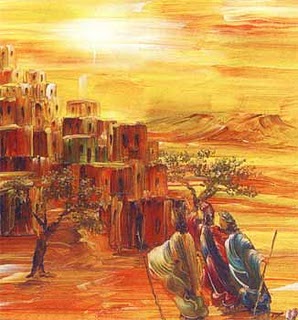
--
The wonderful artwork is from Zaki Baboun, a Palestinian artist who is also famous for his paintings of the Wall around Bethlehem:
--
David Hosey is a seminary student, a songwriter, a gentleman, and a scholar. He blogs at City of...
Thursday, January 5, 2012
OnFire Mission and Vision
Peace and blessings to you all in this new year!
-OnFire Leadership Team
Sara Bayles
Eric Burton-Krieger
Shannon Sullivan
Jen Tyler
Sara Bayles
Eric Burton-Krieger
Shannon Sullivan
Jen Tyler
Calling/Mission:
OnFire is a movement of progressive young adults, following Christ’s example of love, towards the transformation of our church and world.
Direction/Vision:
OnFire participates in transformation by connecting young adults to one another, creating opportunities for education, and mobilizing them to work for justice.
OnFire's Goals and Objectives:
- Connecting Young Adults – build a network of localized groups and individuals engaged in the work of Christ, working together for justice and transformation though the sharing of resources and ideas.
- Opportunities for Education – provide resources and build relationships through experiential educational programs, justice-oriented workshops, our blog, and other opportunities that strengthen and clarify commitments to justice that follow Christ's teachings.
- Mobilizing for Justice - empower local groups and individuals to stand for justice within our church and world through coalition building with like-minded organizations and individuals.
---
Sara Bayles is a senior majoring in Political Science and Religious Studies with a minor in Gender Studies and Honors Interdisciplinary Thesis focused on Social Justice within American Feminism. She is planning to attend seminary in fall 2012.
Eric Burton-Krieger is a co-facilitator for OnFire in addition to being a spouse, recent graduate of Vanderbilt Divinity School, and a candidate for ordination in the West Michigan Conference. He's on staff at Brentwood United Methodist Church and, if you happen to be in Nashville, would love to buy you a cup of coffee!
Shannon Sullivan is a seminary student at Drew in Madison, New Jersey, and is pursuing ordination in the Baltimore-Washington Conference. She is also a member of the OnFire leadership team. She blogs at You'll Never Guess What the Heathens Did Today.
Jen Tyler is a co-facilitator for OnFire as a part of her role as the Associate for Movement Building at MFSA. Jen is appointed to MSFA as a General Board of Global Ministries Mission Intern. She has a Master of Divinity from Garrett-Evangelical Theological Seminary and is a member of the Dakotas Annual Conference, where she is pursuing ordination as an Elder in The United Methodist Church.
Thursday, December 29, 2011
Wrestling and the New Year
2011 has been a year of wrestling. We have seen revolutions arise across the world, we have lifted our voices in support of them and positioned our bodies in solidarity with them and to echo their demands for our own lives. But many of our writers on this blog have articulated another kind of wrestling, not wrestling to make our voices heard, but a wrestling to find God amidst all of this. I still get goosebumps thinking about Michael Airgood talking about taking communion with wrists bruised from handcuffs, Karl Kroger's reflection on his helplessness when he realized Troy Davis was going to be murdered; I still feel warmth reading Jamie Michaels talking about Sing a New Song as a coming together of family, and I am excited about the work Mallory Naake is doing in Peru around food justice. The warmth, the excitement, the helplessness, the confusion--- how do we narrate these feelings? How do we make sense of this past year so we can try to figure out what to do in 2012?
The story of Jacob wrestling from Genesis 32:24-31 is one that has stuck with me as I think about this year:
Jacob was left alone; and a man wrestled with him until daybreak. When the man saw that he did not prevail against Jacob, he struck him on the hip socket; and Jacob's hip was put out of joint as he wrestled with him. Then he said, "Let me go, for the day is breaking." But Jacob said, "I will not let you go, unless you bless me." So he said to him, "What is your name?" And he said, "Jacob." Then the man said, "You shall no longer be called Jacob, but Israel, for you have striven with God and with humans, and have prevailed." Then Jacob asked him, "Please tell me your name." But he said, "Why is it that you ask my name?" And there he blessed him. So Jacob called the place Peniel, saying, "For I have seen God face to face, and yet my life is preserved." The sun rose upon him as he passed Penuel, limping because of his hip.
The story of Jacob has been particularly poignant after reading Black Liberation Theologian James Cone's The Cross and the Lynching Tree (read the book but if you don't have time right now, check out this interview with Bill Moyers here and a lecture about it here). There, he speaks of black religious experience of wrestling, wrestling with trouble, wrestling with doubt, using this story from Genesis. It is a story I don't understand, but I am still drawn to because of the intimacy and the violence all wrapped up together. That is what I have seen this year. I visited Occupy Wall Street in New York right before it was evicted: the intimacy in living all together in tents, under tarps, playing music sitting on the sidewalk, was so beautiful. And yet, there was such violence, as we all saw in that horrifying picture of the police officer pepper spraying the UC Davis protesters.
It is about resistance against the odds. In the face of the increasing militarization of police, in the face of re-encroaching apathy of young people (we thought Egypt and OWS might have been the end of that), in the face of continued occupation of Palestine, in the face of the prison industrial complex, in the face of continued homophobia and heterosexism...God is there, alongside us, wrestling. I think sometimes God is also wrestling us when we can't see the joy in the struggle or when in the struggle we continue to support systems of oppression, or we are wrestling God when we just cannot see God's presence through the pepper spray--- there is this mess of arms and legs flailing about that we can't always separate out and understand. But as we continue into 2012, let us think about this wrestling and know that 2012 will be a year of continued wrestling. Where will we see God face-to-face in this year? Where will we strive with God and with humans for justice and prevail? And where will we find joy in the struggle?
---
Shannon Sullivan is a seminary student at Drew in Madison, New Jersey, and is pursuing ordination in the Baltimore-Washington Conference. She is also a member of the OnFire leadership team. She blogs at You'll Never Guess What the Heathens Did Today.
The story of Jacob wrestling from Genesis 32:24-31 is one that has stuck with me as I think about this year:
The story of Jacob has been particularly poignant after reading Black Liberation Theologian James Cone's The Cross and the Lynching Tree (read the book but if you don't have time right now, check out this interview with Bill Moyers here and a lecture about it here). There, he speaks of black religious experience of wrestling, wrestling with trouble, wrestling with doubt, using this story from Genesis. It is a story I don't understand, but I am still drawn to because of the intimacy and the violence all wrapped up together.
That is what I have seen this year. I visited Occupy Wall Street in New York right before it was evicted: the intimacy in living all together in tents, under tarps, playing music sitting on the sidewalk, was so beautiful. And yet, there was such violence, as we all saw in that horrifying picture of the police officer pepper spraying the UC Davis protesters.It is about resistance against the odds. In the face of the increasing militarization of police, in the face of re-encroaching apathy of young people (we thought Egypt and OWS might have been the end of that), in the face of continued occupation of Palestine, in the face of the prison industrial complex, in the face of continued homophobia and heterosexism...God is there, alongside us, wrestling. I think sometimes God is also wrestling us when we can't see the joy in the struggle or when in the struggle we continue to support systems of oppression, or we are wrestling God when we just cannot see God's presence through the pepper spray--- there is this mess of arms and legs flailing about that we can't always separate out and understand. But as we continue into 2012, let us think about this wrestling and know that 2012 will be a year of continued wrestling. Where will we see God face-to-face in this year? Where will we strive with God and with humans for justice and prevail? And where will we find joy in the struggle?
 |
| Jacob Wrestles the Angel by Arthur Sussman (see more of his work here) |
---
Shannon Sullivan is a seminary student at Drew in Madison, New Jersey, and is pursuing ordination in the Baltimore-Washington Conference. She is also a member of the OnFire leadership team. She blogs at You'll Never Guess What the Heathens Did Today.
Thursday, December 22, 2011
Christmas Eve/Christmas Day
To YOU is born this day...
Luke 2:1-20 (NRSV)
Like many serving churches in some way or another these past few weeks leading up to Christmas have been anything but restful. We often tell our congregations that Advent is about waiting and preparation, that it is a time to be introspective and to slow things down despite societal and consumerist impulses to over-indulge, over-schedule, and over-spend. I find myself even more over-scheduled than usual, as Christmas parties get penciled into my calendar along with pageant rehearsals, special choir rehearsals, additional services... If I am waiting, it is a very busy type of waiting. I tell myself that at least I am preparing myself for Christmas, as I am supposed to during the season of Advent, but what kind of Christmas am I actually getting myself ready for?
Last Sunday I found myself running around the sanctuary (following the two worship services that had been held that morning) trying to help herd hungry children together for the final rehearsal before the annual Christmas pageant, which is performed on Christmas Eve. It is a typical pageant; older children play the role of narrator, reading the familiar words we find in the gospels of Luke and Matthew that, when combined, provide us with the Christmas story many of us know by heart. Mary is a pretty girl wearing blue, the innkeeper is played by an awkward, pre-pubescent boy, and there are three kings. It is the same script from last year, and the year before that, and the year before that; and although there are grumblings that perhaps it is time to rewrite the script, everyone knows that will not happen. People come to Christmas Eve services to hear these familiar words, and if there is one thing worship leaders often learn the hard way it is to not mess with Christmas.
However, I wonder if we do not only the Christmas narrative, but also our congregation members, a disservice in our annual display of adorable children dressed in bath robes. I am all for embodying the W/word, but when it comes to the Christmas narrative God has already done the embodying for us. We are celebrating and remembering the incarnation, when “the Word became flesh and lived among us” (John 1:14). I do not think we can truly begin to grapple with or understand the radical message found within Luke’s text unless we remove the cherubic faces of children from our nativity scenes and search for the faces and stories of those who are placed within that ancient world and our world today.
In this story we find characters that seem incredibly distant, and yet we are surrounded by people just like them each and every day. We think of Mary, a “pure” virgin, who has found favor with God, but who is also an unwed mother whose partner almost abandoned her and who could have been easily ostracized by her community on account of her unplanned pregnancy. Her fiance, Joseph, is a man who works with his hands and does what he must for his family, including traveling an incredible distance because of a government decree. We find a family far from home, without access to health care or support, struggling to find adequate shelter not only for themselves, but for the new life about to be born. Surely, there are Marys and Josephs among us?
In this story we find shepherds, but we do not understand who shepherds were. We envision pastoral paintings and hear the sounds of lutes and harps blending with the gentle baa’s coming from grazing sheep. We do not realize that the shepherds found in the gospels were some of the lowest of the low, men who could not find any other form of work, who lived away from the towns and cities guarding sheep and goats from predators. It was a dangerous job, an undesirable job. It is to these laborers that the angels first come; not to kings, not to white-collar workers, but to the graveyard shift; and the men who fight off wolves and lions are terrified. The angel’s message turns their world, and ours, upside-down: to you is born this day a Savior, who is the Messiah, the Lord. To you, shepherds, and you, day-laborers; to those who are cast down and aside, those who are oppressed, those who are the least, the last and the lost... it is to you that the Lord has come.
Christ continues to dwell among us, and we are called to celebrate the incarnation not only at Christmas, but each day. We find Christ among those we consider to be the least of these, among the sick, impoverished, and oppressed. May we also be Christ, serving those around us, giving voice to the voiceless, as we join the voices of angels and shepherds alike as we celebrate that, for unto us the Son is given.
Amanda Rohrs-Dodge is a third year MDiv student at Drew Theological School in Madison, New Jersey and is the student assistant pastor at The United Methodist Church in Madison.
Like many serving churches in some way or another these past few weeks leading up to Christmas have been anything but restful. We often tell our congregations that Advent is about waiting and preparation, that it is a time to be introspective and to slow things down despite societal and consumerist impulses to over-indulge, over-schedule, and over-spend. I find myself even more over-scheduled than usual, as Christmas parties get penciled into my calendar along with pageant rehearsals, special choir rehearsals, additional services... If I am waiting, it is a very busy type of waiting. I tell myself that at least I am preparing myself for Christmas, as I am supposed to during the season of Advent, but what kind of Christmas am I actually getting myself ready for?
Last Sunday I found myself running around the sanctuary (following the two worship services that had been held that morning) trying to help herd hungry children together for the final rehearsal before the annual Christmas pageant, which is performed on Christmas Eve. It is a typical pageant; older children play the role of narrator, reading the familiar words we find in the gospels of Luke and Matthew that, when combined, provide us with the Christmas story many of us know by heart. Mary is a pretty girl wearing blue, the innkeeper is played by an awkward, pre-pubescent boy, and there are three kings. It is the same script from last year, and the year before that, and the year before that; and although there are grumblings that perhaps it is time to rewrite the script, everyone knows that will not happen. People come to Christmas Eve services to hear these familiar words, and if there is one thing worship leaders often learn the hard way it is to not mess with Christmas.
However, I wonder if we do not only the Christmas narrative, but also our congregation members, a disservice in our annual display of adorable children dressed in bath robes. I am all for embodying the W/word, but when it comes to the Christmas narrative God has already done the embodying for us. We are celebrating and remembering the incarnation, when “the Word became flesh and lived among us” (John 1:14). I do not think we can truly begin to grapple with or understand the radical message found within Luke’s text unless we remove the cherubic faces of children from our nativity scenes and search for the faces and stories of those who are placed within that ancient world and our world today.
In this story we find characters that seem incredibly distant, and yet we are surrounded by people just like them each and every day. We think of Mary, a “pure” virgin, who has found favor with God, but who is also an unwed mother whose partner almost abandoned her and who could have been easily ostracized by her community on account of her unplanned pregnancy. Her fiance, Joseph, is a man who works with his hands and does what he must for his family, including traveling an incredible distance because of a government decree. We find a family far from home, without access to health care or support, struggling to find adequate shelter not only for themselves, but for the new life about to be born. Surely, there are Marys and Josephs among us?
In this story we find shepherds, but we do not understand who shepherds were. We envision pastoral paintings and hear the sounds of lutes and harps blending with the gentle baa’s coming from grazing sheep. We do not realize that the shepherds found in the gospels were some of the lowest of the low, men who could not find any other form of work, who lived away from the towns and cities guarding sheep and goats from predators. It was a dangerous job, an undesirable job. It is to these laborers that the angels first come; not to kings, not to white-collar workers, but to the graveyard shift; and the men who fight off wolves and lions are terrified. The angel’s message turns their world, and ours, upside-down: to you is born this day a Savior, who is the Messiah, the Lord. To you, shepherds, and you, day-laborers; to those who are cast down and aside, those who are oppressed, those who are the least, the last and the lost... it is to you that the Lord has come.
Christ continues to dwell among us, and we are called to celebrate the incarnation not only at Christmas, but each day. We find Christ among those we consider to be the least of these, among the sick, impoverished, and oppressed. May we also be Christ, serving those around us, giving voice to the voiceless, as we join the voices of angels and shepherds alike as we celebrate that, for unto us the Son is given.
Amanda Rohrs-Dodge is a third year MDiv student at Drew Theological School in Madison, New Jersey and is the student assistant pastor at The United Methodist Church in Madison.
Subscribe to:
Posts (Atom)