Guide my feet while I
run this race, (yes, my Lord!) Guide my feet while I run this
race, (yes, my Lord!) Guide my feet while I run this race, For
I don't want to run this race in vain! (race in vain!)
-African-American
Spiritual
On April 4, 1968,
Dr. Martin Luther King, Jr. was killed by a shot from a sniper’s
bullet while he stood on the balcony of the Lorraine Motel in
Memphis, Tennessee. He was 39 years old. This past April, we
commemorated the 45th year since the assassination of
Martin Luther King, Jr. who will always be in history books for years
to come for the hand he had in the civil rights movement. It’s hard
to even think of the civil rights movement without Martin Luther
King, Jr.
MLK had traveled to
Memphis, Tennessee to support the striking of African-American
sanitation workers. The workers had participated in a walkout earlier
in February to protest the unfair wages and working conditions they
experienced at their workplace. He had spoken the day prior to his
death to a gathering at the Masonic Temple known as the speech, “I’ve
Been to the Mountaintop.”
Excerpt: “And
then I got to Memphis. And some began to say the threats... or talk
about the threats that were out……….. But I'm not concerned
about that now. I just want to do God's will. And he's allowed me to
go up to the mountain. And I've looked over. And I've seen
the Promised Land.”
Despite receiving
bomb threats against his plane before got to Memphis, he understood
the work of God in his life and his life’s mission to bring the
Promised Land to all people. He understood the need to support
workers, the need for righteousness in the face of injustice. He
understood the need for economic justice for the plight of
African-American workers.
Has things changed
in these times? No!
I can draw a lot of
parallels between the Martin Luther King, Jr.’s speech concerning
the Memphis Sanitation Strike and the undocumented immigrant in this
highly-political climate with the event that happened a couple weeks
ago, and the struggle of the undocumented immigrants.
Today, the
undocumented immigrant has experienced abuse from their unscrupulous
employer who steals their wages (wage theft), exposes them to
hazardous working conditions, and intimidates them with threats of
calling U.S. Immigration and Customs Enforcement if they complain, or
try to organize other themselves.
What kind of life
is it to work in a low-wage job providing essential labor such as
farming and having to live in the shadows in constant fear?
Moreover, similarly
as Martin Luther King, Jr. received a bomb threat, we witnessed the
tragic Boston bombings and some lawmakers have cited the Boston
bombing as example if Congress carries immigration reform too far.
They want to use the incident to heighten enforcement and deny
citizenship for the estimated eleven million undocumented immigrants
in this country. It has revitalized a certain xenophobia and anxiety
in America.
MLK did not let the
bomb threat affect his vision, but he stood the course, and we should
not let the bomb threat prevent us from seeing the vision either.
We should not allow
politicians to use the Boston bombing as a ploy to inhibit
immigration reform from happening. We are too close now to let
immigration reform fall right under us…..I have seen the Promised
Land
Let’s stay the
course my brothers and sisters and not derail from our work on
immigration reform. I mourn for the folks that were injured or killed
in the Boston bombing, but I stand with a much heavier heart seeking
the Beloved Community that MLK speaks of in light of this travesty.
We must commit
ourselves to the Beloved Community of MLK. Martin Luther King, Jr.
understood and saw the Promised Land for Civil Rights, and now we see
the Promised Land for Immigration Reform where all of our immigrant
brothers and sisters are respected and their dignity is acknowledged.
Let’s stay
the course……
Today on May Day
(International Workers’ Day), I will walk through the city streets
where the Haymarket massacre occurred in Chicago with my co-workers
at Interfaith Worker Justice (IWJ) to protest for immigration reform
for immigrant workers seeking full citizenship and be ensured of
their workers’ rights.
I have seen the
Promised Land. My eyes have seen the Promised Land and I know that we
can get there together!
---
Mistead Sai is a
US-2 missionary for the United Methodist through the General Board of
Global ministries. Mistead Said serves at Interfaith Worker Justice
(IWJ) as their Worker Center Network Assistant providing support to
worker center affiliates nationwide. Mistead received a Bachelor of
Arts in Sociology at the University of Maryland. He enjoys
intellectual conservations, likes documentaries, and has taken a
liking to investigate issues surrounding environmental racism,
biopolitics, and identity politics in the past recent months.
Sitting in a crowded room filled with activists from all over the world in the basement of a building off a side street of the city I was brought back to the days of sitting in the basement of the Kay Spiritual Life Center at the American University for a variety of grassroots planning and United Methodist and CASJ meetings focused on the call to justice and action.
Although this room was filled with United Methodists, much like the days at the university, the colored faces of those around me told of much longer, much harder and much more diverse stories than the faces of my university colleagues. Already in my participation in the United Methodist delegation to the People’s Global Action during the past three days, I have been inspired by the stories that have been shared and anticipate that many more such stories will be shared over the course of the coming days during my time here in Geneva.
This week I am here in Geneva taking part in the United Methodist delegation to the People’s Global Action on Migration, Development and Human Rights. The People’s Global Action (PGA) is a low-level, self-organized collective of activists, NGOs, and religious organizations working on issues of migrants’ rights and recognition. The meeting of the PGA is being held concurrently with the Civil Society Days, a gathering for NGOs and academics working on issues of migration, as well as the private sector. Both of these more grassroots level meetings have taken place on an annual basis since 2006 in response to the meeting of the Global Forum on Migration and Development (GFMD), which will once again meet later on this week here in Geneva. The GFMD is the only inter-governmental forum on migration and serves as a private process, which is completely independent from the United Nations (UN). Unlike the security focus of the GFMD, the Civil Society Days and the PGA seek to bring a focus on human rights and human dignity into the center of the discussion and dialogue on migration.
During my first day here at the forum, I remained uncertain of my role here as one member of the United Methodist delegation thrown into the meeting of an organization and a movement to which I previously had neither ties nor active experience. I couldn’t seem to shake the doubt in my mind and the lingering request for honesty and reality – will the conversations we have, the emotions that are exposed, the things we learn, the people who we meet, and the stories we share actually make a difference?
By flying people from around the world to Geneva and putting us up in hotels and feeding us overpriced Swiss food change the lives of a single child with migrant parents? Or prevent the deportment of an undocumented person?
During the past two days I have, however, grasped a thread of hope that the networks which are being built, the discussions being held, and the presence of each individual and delegation here does in fact present the possibility to change the reality of migration in today’s global world.Since 2006 the People’s Global Action and Civil Society Days has, in fact, already helped to bring human rights more into the focus of the Global Forum on Migration and Development; this grassroots level meeting has worked to influence policy, including the Domestic Worker’s Convention passed in June of this year. Inshallah, our presence here might also have such outcomes – not only at the international level, but also for the average migrant, the mother working to earn a living for her family, the father awaiting deportment in a detention center, and the child seeking justice, recognition, and simply love as a child in a strange land.
Michelle Dromgold is a Mission Intern of the General Board of Global Ministries of the United Methodist Church. She is currently serving at the Kindertreff Delbrücke at the Salem Gemeinde in Berlin, Germany. There, she works as a social worker with an emphasis on intercultural and interreligious dialogue amongst the children and youth at the after-school program and with local United Methodist Congregations.
I must admit, I came to Sing a New Song with some mixed emotions. Less than a month ago I left the staff of the Methodist Federation for Social Action (MFSA) to prepare for seminary, which I will begin next week at the Boston University School of Theology. I wondered if it was too soon for me to return to “work,” whether it would be hard for me to watch others carry the torch as I stepped back for a bit. After all, I wanted to take some time to discern how I would carry my recent experiences in social justice ministry to seminary and beyond.
While laying low, I attended a workshop on environmental racism, hearing afresh the staggering inequalities in access to clean and safe living spaces, while learning how churches can facilitate local grassroots efforts to improve lives. Later I caught up with Susanna McKibben who gave a session entitled, “Immigration: Rhetoric and Realities.” Susanna also guided the OnFire delegation in an immersion trip to the Arizona-Mexico border, not long before the passage of SB1070. I also participated in a phone bank to make preliminary contacts to General and Jurisdictional Conference delegates to ask for their support in ending the harm to gay, lesbian, bi-sexual, and transgender persons (five calls made!), and I pledged to meet with at least one delegate to General Conference before next April.
Sitting near the back of worship one morning, a dear mentor leaned over to me and asked, “well, Jennifer, did you ever think you’d be sitting here when you arrived back from Germany [in 2008]?” “Nope,” I replied, as I returned my gaze to a room filled with color and song. And it hits me: I have been transformed. The music, the people, the travel, the education, the organizing, the relationships, the phone calls. I have never decided how the Spirit moves. I do not determine the “right time” to engage. I am not the one who carries the ministry of justice, but rather I am carried by a movement of people who are responding to a lifelong, ever-present call to being and doing church. I can’t wait to see where the Spirit carries us next.
Jennifer Mihok will soon be a first year MDiv student at the Boston University School of Theology and is seeking candidacy in the Baltimore-Washington Annual Conference. Before joining the staff of MFSA in 2009, Jennifer served a United Methodist congregation in Genthin, Germany as a mission intern with the General Board of Global Ministries.
The symposium was so beautifully woven together with lecture, worship, discussion, and art. We began with worship, opening with a song whose lyrics were "I am not forgotten; God knows my name"--- a powerful reminder of that communion of saints for whom we gathered today to stand up against the violence that makes people "forgotten."
For there are indeed so many who are pushed into forgotten-ness. Dr. J. Terry Todd, Drew professor and member of the keynote panel "How is the Hate Sponsored in Church and Society? How is the Hate Countered?" along with doctoral biblical studies student Rosario Quinones and civil rights lawyer Fred Brewington moderated by Dr. Traci West, spoke about the three periods of anti-immigrant fervor in the USA, weaving political cartoons from the 1880s with pictures from Tea Party rallies to reveal how the same rhetoric gets repeated again and again. And though he began by focusing on immigration, he reminded us that it is not coincidental that the rise of the Klu Klux Klan coincided with the period of anti-immigrant fervor from 1880-1924.
He ended his part of the lecture with the 1972 adoption of what has become known as the United Methodist Church's incompatibility clause: "homosexuality is incompatible with Christian teaching." Originally, the Committee on Christian Social Concerns wrote a sentence to declare acceptance of people of all sexual identities, recognizing everyone's sacred worth, but on the floor the language was changed to "incompatible." Fred Brewington said during his part of the panel that the incompatibility clause turns the bible into a weapon. And that, we began to see, is hate speech.
The day really centered around showing us of the intersectionality of anti-immigrant, racially-based, and homophobic hate crimes, as you can see from the keynote panel. The literature also reminded us about those hate crimes against Muslims in the city this year, though it was not covered as much throughout the day. There was a theatrical performance brought to us by the Teatro Experimental Yerbabruja out of Long Island, that spoke to us of the real-life events of the murder of Marcelo Lucero, thus documenting how hate crimes happen. Here, we kept hearing the words so prevalent today in our own anti-immigrant fervor: "It's not about race, it's about rule of law." And we kept seeing the bodies of immigrants broken and bruised alongside these words, proving how empty those words really are.
The blood of those impacted by the hate is, like Abel's, crying out from the ground. We must move, as we prayed at the end of the symposium, to compassion, action, and justice to repent from this sin of fear.
Then it was back to the sanctuary for a performance of "What Killed Marcelo Lucero?", a play written by a Long Islander about this hate crime against a Hispanic immigrant which resulted in the man's death in 2008. It was a very powerful play. I was particularly struck at the end when the cast members walked through the sanctuary with the coffin, which had painted upon it not just the American or Ecuadorian flag but flags from all different nations. I found myself wondering exactly how many immigrants from each of those countries had suffered hate crimes and abuse in our country. It was a very sobering moment.
...
So here I share with you something that I was pondering during this event. Some background here is that I have already been pondering exactly what is God's nature, who does God accept into the family, and what are the conditions, if any?
I wrote in my journal that day "How do we understand God? Is God this one that has been constructed throughout history? Or is God beyond this understanding and actually open, accepting AS YOU ARE, and God's goal is making you more fully you rather than more fully what the church says you should be? I mean, who decides what it looks like to become "more like God"? Isn't the picture we've been taught one that is in line with a mainline, patriarchal, white understanding of who God is and what God desires?"
I think the part that I want others to take with them and ruminate upon is the part that I want to continue to consider: what if God's goal for us is not for us to become more like this static idea of a "good Christian" but for us to become more fully ourselves? Who constructs the picture of "good Christian"? Do we truly believe that this idea of "good Christian" is constructed by God? I'm not convinced of this. I see a history of the church, especially in America, pushing people to become normalized into the mainstream culture of Christianity. Throughout our history, we see the church telling people how they have to look and act and think in order to be accepted. I'm not sure God cares about these things as much as the church does. What would it look like if we simply sought God and strove to be more fully the people we actually are? What if, instead of seeking to be more like the church wants us to be, we strive to understand who God has created us to be and strive toward that fully realized self? If we can understand God as not only accepting us as we are but also desiring to make us better and more fully functioning versions of ourselves, maybe we can open the church doors a little wider to let in those unlike us. If we can believe that God creates diversity (of thought, appearance, and lifestyle) and wants that diversity to become more fully realized, maybe we can let those who differ from our own idea of God into the family. If we can understand God in this way, perhaps at the very least we can open our ears to hear what someone with whom we disagree thinks.
I have to admit, I rather like this idea of God over the one in which I am expected to conform to a certain set of standards and appearances that may or may not fit the person I actually am. I have trouble with the idea that God created me the way I am simply to make me different. I know some of you will say to me, "The old is gone, the new is come!" (II Corinthians 5:17), and I'm not particularly throwing this verse out. I know many of us feel that we are better now than we were before coming to faith in God. What I'm saying is that sometimes we are told we have to change fundamental parts of the person we are deep inside in order to become real and good Christians. Maybe, in fact, God wants to tune and hone those fundamental parts of ourselves and more fully integrate them into our personhood, making them useful, even integral, to our lives in Christ. I think that "the old" here refers to destructive ways that damage the person God created us to be. "The new," on the other hand, would be a version of ourselves that is fully who we are, able to fly with the wings we've had inside us all along.
To educate yourself more about hate crimes and what people of faith need to be doing to confront them, visit the Center for Preventing Hate and join the conversation on the My Brother's Keeper Facebook page.
I began to understand the importance of comprehensive immigration reform not in interactions with immigrant communities in the USA, with whom I had little contact despite living in a farming community, but in studying abroad in France and traveling across Europe. In France, I took sociology and history classes that touched on the social impact of migration of maghrébins (North Africans primarily from Algeria but also Morocco and Tunisia)--- a particularly salient issue as there have been riots in these ethnic communities that have received national attention (in 2005 mostly, but this is not new or over--- watch the film La Haine [Hate] for an artistic exploration of this social dynamic). I spoke with my host family and other French people about Islam and immigration. And I began to see how across Western Europe, immigration is a hot button issue--- from the insanity of the border security in the UK (I stood in line once as the only white person in a long line of brown men in Heathrow for "random" security checks--- I was the evidence that they were supposedly not racially profiling), to the debates over whether or not Turkey should be admitted into the European Union, to learning about Turkish immigration to Germany and initial attempts to prevent Muslims from becoming citizens. In October 2008, one of my best friends, a Bosnian woman (so a woman from the "other" Europe and a Muslim---read: not white enough), was supposed to come visit me but her ticket was revoked when it turned out she needed a visa in order to land in Germany twice (she had two layovers in Germany and would have spent a grand total of two hours in the country). So I began to study the insanity of xenophobia (fear of the foreign) in my own country (you can check out some of my reflections here).
The news today turned me back to the mess that is xenophobia in Europe. Last month, French president Nicholas Sarkozy announced mass deportations of Roma immigrants (more commonly, though derogatorily, known as gypsies--- for more of an explanation check out the Slate article called "Why do the Roma wander?").
"Hey, hey Sarkozy why don't you like the gypsies?" (VAMA feat. Ralflo's "Sarkozy versus Gypsy")
This is nothing new, of course: Italy, for example, declared a state of emergency in 2008 "due to the presence of Roma" and, let's not forget, during the Holocaust, the Nazis exterminated 220,000 Roma in its attempt to "purify the race."
And, for the French government, such despicably racist and xenophobic policies are nothing new. They are forever trying to ban the veil and blaming young men of color for everything wrong in the world. Last September, police invaded and dismantled a migrant camp in Calais. This event has stuck with me these past months because I have often wondered where those families went and what it was like to live through such a traumatic experience of loss.
Thursday and Friday, French police began the ethnic cleansing* program, resulting in the removal of some 700 people and a dismantling of 40 Roma camps, according to the BBC. Robert A. Kushen, executive director of the Budapest-based European Roma Rights Centre, pointed out in an interview for the New York Times that "Mass expulsions based on ethnicity violate European Union law...and the failure of France to do individual assessments of each case--- as opposed to cursory examinations of papers by the police--- also violates European Union rules." Sound familiar?
If that does not sound familiar what about this story from the UK's The Guardian:
Although [an unnamed 27-year-old Romaian man] has lived in Marseille since he was child, he still has no papers, and cannot get a job. "This discrimination will not go away. France has become the opposite of liberty, equality and fraternity," he said. Asked about any friends and acquaintances among the 1040 people to have gone home "voluntarily" from Marseille to their native countries since January last year, he said he doubted they would have gone happily. "Even in Romania you had discrimination," he remembered. "No one wants us. There is no place for us. Not in Romania, and not in France."
I read these articles and am constantly reminded of the stories of refugees denied asylum in the USA, of immigrants who arrive in the USA as children and know nothing of their "home countries" and yet are deported, of USAmerican politicians who are attempting to overturn the fourteenth amendment to deny citizenship to USAmerican-born children of immigrants. Xenophobia is not exclusive to the USA, which is something we must remember as we are fighting for comprehensive immigration reform in our own country. The reason for the French government's stance on immigration is an appeal to the populist vote--- much like the increase secure-the-border furor in the USA. This is a problem across the world--- and not just in the global North: in South Africa, for example, there have been violent attacks against immigrant communities. While we do need to focus on policy and reforming immigration law step by step in the USA, we need to be thinking globally of how we can create a world in which we welcome strangers rather than demonizing them.
"Come, you blessed of my Abba God! Inherit the kindom prepared for you from the creation of the world. For I was hungry and you fed me; I was thirsty and you gave me drink. I was a stranger and you welcomed me; naked and you clothed me. I was ill and you comforted me; in prison and you came to visit me...The truth is, every time you did this for the least of my sisters and brothers, you did it for me."**
***
The title of this blog, comes from a quote in a New York Times piece from Ioan Lingurar.
* I know a lot of activists reject using the term ethnic cleansing when talking about Arizona's SB1070 and other anti-immigrant policies because its connection to the Bosnian genocide such a term brings with it. I am not suggesting that we forget that the term ethnic cleansing served as a euphemism for genocide. However, I am asking that we look at the definition of ethnic cleansing--- the forced removal of an ethnic group from a geographical area--- and use the weight of the term to name the reality of anti-immigration policies like France's.
**Matthew 25: 34-36,40, The Inclusive Bible: The First Egalitarian Translation, Priests for Equality (Sheed and Ward 2007).
“We will not comply! We will not comply!” filled the air in downtown Phoenix on Thursday, July 29th – the day that Arizona’s harshly anti-immigrant bill SB 1070 went into effect. I was co-leading a BorderLinks delegation of faith leaders from across the U.S. who came to be in solidarity against SB 1070. We watched as small groups of people were arrested in an effort to take a public stand against the law. A few hundred people took over one city block downtown to raise their voices in protest; police in full riot gear worked their way into the middle of the crowd and gradually separated them until all protestors were pushed back onto the sidewalks. On one side of the police unit was a crowd of people yelling, “Cops and the Klan go hand in hand!” while on the other side a line of Unitarians spanned the crosswalk sporting their yellow “Standing on the Side of Love” t-shirts. The tension in the air was as tangible as the humidity.
Back in Tucson that afternoon, we joined with a crowd of people who had taken over the intersection between the State Building and the Federal Courthouse. I recognized many faces in the crowd, for this is a community that has mobilized frequently in recent months in response to the constant public attacks on immigrants. In March we organized in response to an ICE raid that shut down the Southside, where many immigrant families live. In May over 7,000 people hit the streets of Tucson for a May Day March in support of just immigration policies. We’ve seen youth leading the actions in protest of SB 1070 and HB 2281 (which bans ethnic studies programs in public schools). The voices of Arizona communities are rising in incredibly powerful ways against the strong tide of racist fears and nativism that have become the public face of Arizona.
Several young adults held signs proclaiming, “Undocumented and Unafraid”, and my stomach churned when I saw them. They may not be afraid, but I am. What if they really are undocumented and they get arrested? Will they be deported, or can they fight for their cases in court? What abuses will they suffer in the process? Do they know anyone in Mexico, and do they even speak Spanish? If they want to return to the U.S., will they cross the deadly Sonoran desert to reunite with their families? It hurts me to even imagine being forcibly separated from my family, and I know people in Tucson who live in daily fear of that happening to them. God of justice and love, we are lost in the wilderness! What have we become, that we ignore hundreds of deaths in the desert every year while our media plays on popular fears about immigrants? What have we become, that we would dehumanize people in the name of upholding bad laws? That we ignore our own complicity in the drug trade, migration, global economics, and the separation of families?
The interaction between protestors and police was relatively calmer in Tucson than in Phoenix, but it was clear in both cities that not everyone agrees on tactics or messaging. While some see the police as enemies, others see them as potential allies. Some want to talk about racism, others want to avoid that word altogether. There is no single, clear path for reaching the transformation we seek. I’ve been struggling with this question a lot recently: Should we push for smaller goals that may seem more practical and attainable, or is that compromising too much? Should we hold out for our ideals, or is that so unrealistic that it prevents any change from happening at all? Let me give you a concrete example: there’s been much debate about the border wall and border security. Some pro-immigrant groups attempt to build alliances by saying “Of course we all want to secure the border. We can all agree that we don’t want open borders.” For border communities, border security has come to mean militarization, destruction of fragile ecosystems, alienation of communities from each other, and human deaths in the desert. The border is much more nuanced than simply “open” or “closed”, and the phrase “border security” doesn’t fully communicate what happens down here on la frontera. Another example: should we be talking about NAFTA (North American Free Trade Agreement) reform on a national level, or focusing only on reforming our immigration policies? I believe that large-scale immigration will continue as long as we fail to address how international agreements and business practices destabilize local economies and force people to leave their home communities. But some would say that talking about NAFTA reform is too big and controversial, and won’t ultimately get us anywhere.
Conflicts over how to push forward and what to push for have already been dividing our movements for immigrant justice, and part of me fears that we’ll never get it together enough to get something done. The other part of me is humbled by the multiplicity of people who are passionately working to transform the U.S.’s policies, public messages, and social assumptions about immigration. I live in this tension between differing approaches to the task before us, and here on the border we both struggle with and celebrate each other’s perspectives. I place my hope in a people who can come to recognize where our shared values meet, who continue being passionate without denying the humanity of others, who see the ripple effects of decisions we make today. I place my hope in a God who is in the midst of all this muck and chaos and beauty that we’re living in. Gracias a Dios que la lucha sigue!
Margi Ault-Duell works as a Program Organizer for BorderLinks in Tucson, AZ. Her work focuses on educating people from across the nation about the U.S.-Mexico border, the causes and effects of immigration, and the ways that power, privilege, and oppression weave throughout our lives. She's a United Methodist young adult and recent graduate from Drew Theologial School.
Greetings OnFire bloggers and readers. Tomorrow, anti-immigrant law SB1070 was supposed to go into effect. This is an update from the Associated Press.
PHOENIX — A judge has blocked the most controversial sections of Arizona's new immigration law from taking effect Thursday, handing a major legal victory to opponents of the crackdown.
The law will still take effect Thursday, but without many of the provisions that angered opponents — including sections that required officers to check a person's immigration status while enforcing other laws. The judge also put on hold a part of the law that required immigrants to carry their papers at all times, and made it illegal for undocumented workers to solicit employment in public places.
U.S. District Judge Susan Bolton put those controversial sections on hold until the courts resolve the issues.
Opponents say the law will lead to racial profiling and is trumped by federal immigration law.
But in celebrating this federal court ruling, let us not forget that this bill's existence is just another example of institutional racism that contributes to the culture of fear that is a daily reality for so many immigrant communities. Let us continue to pray and stand in solidarity with those fighting against SB1070 and those who continue to push for comprehensive immigration reform.
To learn more about what parts of SB1070 will still go into effect tomorrow and what has been blocked, check out an article from the Arizona Daily Starhere.
Rock me mama anyway you feel
Hey mama rock me
Rock me mama like the wind and the rain
Rock me mama like a south-bound train
Hey mama rock me
-"Wagon Wheel," Bob Dylan; Old Crow Medicine Show
The border, la frontera, is death. Again and again when I was in Nogales I heard this expressed by people who call the border home, people whose existence is this increasingly militarized space. Again and again, I saw white crosses, x's that marked the spot, signifying the death in the desert along that line drawn in pencil by men far, far away.
There is a dusty fear here. As a member of the OnFireBorderlinks delegation in October 2009, we traveled from Tucson to Nogales to Altar and back. These memories hit me this week as I sat in front of a computer working at Faith in Public Life when I came across this article by Elliot Spagat from the Associated Press:
ALTAR, Sonora- Very few residents dare to drive on one of the roads out of this watering hole for migrants, fearing they will be stopped at gunpoint. They worry they will be told to turn around after their gas tanks are drained or, worse, be kidnapped or killed.
A shootout that left 21 people dead and six wounded on the road last week is the most gruesome sign that a relatively tranquil pocket of northern Mexico quickly is turning into a hotbed of drug-fueled violence on Arizona's doorstep...
Nogales, the main city in the region, which shares a border with the Arizona city of the same name, has had 131 murders so far this year, nearly surpassing 135 for all of 2009, according to a tally by the newspaper Diario de Sonora. That includes two heads found Thursday stuffed side-by-side between the bars of a cemetery fence.
The carnage still pales compared with other Mexican border cities, most notably Juarez, which lies across from El Paso, which had 2,600 murders last year. But the increase shows that some small cattle-grazing towns near Nogales are in the grip of drug traffickers who terrorize residents...
"If no one puts a stop to this, these will become ghost towns," said Jose Martin Mayoral, editor of Diario del Desierto, the newspaper in Caborca....
That phrase ghost towns echoes in my mind as I sit here, so far from this fear on the border yet still so affected by it. When I sat down to write this post, I thought about what it was like to sit in a van in Altar looking out into the desert at the road people took to get to the U.S.A. without documents. We couldn't get out of the van because the entrance to the road was patrolled by gangs. I wanted to write about NAFTA and the failed war on drugs, corruption and USAmerican citizens' own complicity with the violence that is migrating over this border in the way people are forced into drug and human trafficking. I wanted to compare the low levels of violent crime in USAmerican Border cities with the fact that Ciudad Juarez, just over the border from El Paso, Texas, is one of the most violent cities in the world.
Yet as I read this Associated Press article and think about what Altar and Nogales meant to me and why I am so saddened to read about the violence on the border, the image that keeps coming into my head is that of José, an eighteen year old who looked so much younger who came to the migrant shelter in Altar the night we were there. He was alone. I didn't get much of his story and don't know if any one of us did, but what I remember about José was the quiet way he sang along to the music as my friend David played guitar in the courtyard to the shelter. We sang song after song as the sun set and the coolness of the desert at night set in around us.
The sacred to me was in the movement of José's lips as we sang "Wagon Wheel" until the haunting beauty of the song dissipated in the darkness and we entered the shelter to eat.
As I continue to sit in front of a computer, I meditate on the movement of God in that moment and I just wish I could give it to you, the way the night air felt against my skin, the sound of Susanna's voice as she led us all in the song, the weight of it all. Would it change you, would it make you ask more questions, make you stop and think when you read about the increased violence of border cities on the Mexican side of the border?
"Wagon Wheel" is a song about traveling south, about getting to Raleigh to be with a lover, where if he died in Raleigh, he says "at least I will die free." I don't know if José ever made it north, but if he did, he only had a few months before SB1070 reminded the rest of us how undocumented people living in this country are not free, continuing to live in prisons of fear from a different violence. José reminds me why we need comprehensive immigration reform so badly, why I pray he is neither living in the border cities in Mexico nor in Arizona but that he has a chance to live free of that fear. That we all have the chance to live free of that fear.
This blog was originally posted at OnFire member David Hosey's City of...blog.
Tell me if this sounds familiar:
A new order allows enforcement officials to stop anyone who “looks illegal” (read: has brown skin) and demand that they produce documents proving their right to be in a place they call home. Failure to produce such documents can lead to fines, jail time, or deportation. Widely seen as a violation of basic rights, this new order leads to widespread calls for boycott.
I’m speaking, of course, about Arizona’s new racist law, SB1070–but I could just as easily be talking about Palestine/Israel.
If you haven’t heard, SB1070 effectively mandates racial profiling by giving local police officers the right to demand immigration documentation from anyone they think might be in the country without documents. Here’s theWashington Post summarizing the new law (and insisting on calling human beings “illegal”):
“The law gives local police broad authority to stop and request documents from anyone they reasonably suspect is an illegal immigrant. It calls for aggressive prosecution of illegal immigrants, and officers can be sued if they do not enforce the law.”
I support these calls, just as I support efforts to oppose so-called “Secure Communities” initiatives that would require local law enforcement to work with Immigrations and Customs Enforcement (ICE) in a manner sure to promote racial profiling and ruin community policing efforts.
I have to wonder, though, how calls to boycott Arizona–including sports boycotts and boycotts on travel to the state–are so easily endorsed in theWashington Post (McCartney: “I like the idea of a boycott because it’s so all-American”), while calls to boycott Israel for its consistent violations of Palestinian human rights and international law are deemed “controversial.”
The connections are eerie: earlier this month, a new Israeli military order came into effect in the Palestinian West Bank, which would allow the military to demand that any Palestinian, anytime, produce proof of their right to be in their home. According to the Israeli newspaperHa’aretz:
“A new military order will take effect this week, enabling the army to deport tens of thousands of Palestinians from the West Bank and prosecute them on infiltration charges, which carry long prison terms….The order’s vague language will allow army officers to exploit it arbitrarily to carry out mass expulsions, in accordance with military orders which were issued under unclear circumstances. The first candidates for expulsion will be people whose ID cards bear addresses in the Gaza Strip, including children born in the West Bank and Palestinians living in the West Bank who have lost their residency status for various reasons.”
Sound familiar? As with SB1070, the Israeli military order purports to be in response to illegal migration (“infiltration”), but is actually a license for racial profiling and mass deportation–i.e., ethnic cleansing. And yet where was the Washington Post call for boycott?
And SB1070 is likely to lead to the type of checkpoints and arbitrary “searches” and arrests that have been daily reality for West Bank Palestinians for decades. The West Bank currently has over 500 checkpoints, roadblocks, and closures–in an area the size of Delaware, not Arizona.
Of course, in Arizona and in Palestine/Israel, many of the people affected by racist laws and policies can trace their ancestral connection to the place back well before the current (predominantly white-skinned) regimes making such racist laws came into power. That’s how colonialism and occupation works. And as Jewish Israeli Assaf Oron writes at DailyKos, racial profiling linked to ID documents is a fact of life for Palestinian Arab citizens of Israel as well.
So here’s what I’m saying: all those calling for boycotting Arizona because of a racist “documentation and deportation” law–I’m with you. And everyone who supports the Palestinian BDS call should be with you too. But we’re asking you to support boycotts targeting such racist laws, mandating displacement and ethnic cleansing, that are supported by U.S. policy and U.S. corporations, no matter where these “laws” are being made.
Now is the time. It’s the right thing to do. And it just makes sense.
–
For more information on how you can get involved with boycott, divestment, and sanctions (BDS), check out the US Campaign to End the Israeli Occupation’s BDS resources. And check out the following video from Al Jazeera for more on the new Israeli military order that could lead to the displacement of thousands of Palestinians from their homes in the West Bank:
The most recent issue of UMConnection, the newspaper of the Baltimore-Washington Conference of the United Methodist Church, has a great article about United Methodist participation in the immigration reform rally, including quotes from UMOnFire staff Jen Mihok, a reference to our BorderLinks trip, and a front page photo of OnFire members. Check it out:
United Methodists call for immigration reform
BY JOHN W. COLEMAN SPECIAL TO THE UMCONNECTION
Baltimore-Washington Conference churches were represented among the tens of thousands of marchers who gathered in the nation’s capital March 21 to call for improvements in U.S. immigration laws.
“The time for comprehensive immigration reform is now,” proclaimed United Methodist Bishop Minerva Carcaño of Phoenix, Ariz., leader of the Desert-Southwest Conference.
She joined a diverse procession of speakers representing religious bodies, advocacy organizations, labor unions and other groups. They urged Congress and President Barack Obama to move the issue to the top of the legislation agenda.
Churches from Washington, D.C., to Frederick, Baltimore, Hyattsville, Oxon Hill and other areas of the conference joined the colorful, enthusiastic, noisy throng of marchers, many of them shouting “Si, se puede” in Spanish and “Yes, we can” in English. Parading with signs, banners, baby strollers and even marching bands, they filled nearly five blocks on the national mall near the U.S. Capitol.
“This country says to you, ‘Harvest our fields, build our homes, take care of our children, serve our tables, clean up after us and then be gone,’” Carcaño told listeners.
She and other speakers called for humane, viable policies and procedures that would allow about 11 million immigrants now in the U.S. illegally to attain legal status and to work and live with their families, safe from intimidation, arrest and deportation.
Carcaño, who chairs two of the denomination’s immigration task forces, called current laws and enforcement “a shameful state of affairs for a country that prides itself on providing justice for all.”
Hundreds of United Methodists were seen gathered and scattered among the crowd with identifying shirts and signs. They came via trains, cars and buses, some from across our region, others from across the nation, many riding all night to be a part of history.
“We have voices and power, and we are here to say we want this to be a fair and just system that treats people with dignity and respect,” said David Hosey, who attends Dumbarton UMC in Washington. He is a mission intern with the General Board of Global Ministries.
Part of the church’s active young adult group, he and others visited both sides of the border in Nogales, Ariz., and Nogales, Mexico, last October. They met with Mexican migrant workers and high school students through the BorderLinks program. “We saw the economic disparities and pressures they suffer,” he said. “They’re looking for opportunities, jobs and hope for their families.”
Jennifer Mihok, a member of Woodside UMC in Silver Spring and a mission intern at the Methodist Federation for Social Action, coordinated the trip. “I’m here because I don’t need to be in the shadows when so many others have to be,” she said.
“This was an amazing experience and a strong statement for our country to address the need for comprehensive immigration reform” said the Rev. Edgardo Rivera, who coordinates Hispanic/Latino Ministries for the Baltimore-Washington Conference. “Offering a path to citizenship for undocumented people and protecting them from harm and exploitation is an issue of justice and hospitality. I’m pleased to see our church represented here.”
Valerie Hames, of First UMC Hyattsville, worked with others across the conference since December to promote the march and organize buses to bring in church members. “But when I finally saw all the people gathered there at the march, I was overwhelmed,” she said. “The energy there was great, and hearing victims of enforcement and broken families speak their pain — especially one little boy — really resonated with a lot of people and opened their eyes and hearts to this problem.”
Hames, who came here from Sierra Leone 20 years ago, endured her struggles with the inefficient, expensive immigration legal system before finally receiving her green card just this year.
She is a volunteer in the Justice for Our Neighbors (JFON) immigration legal assistance ministry at First Church Hyattsville, and she chairs the conference’s oversight committee for the program which operates in three locations.
“I brought JFON volunteers to the march for them to see how important this ministry is to people’s lives,” she said. “And I felt stronger about my own involvement in JFON when I left there.”
The drums playing behind us drowned out the speakers, but it didn't matter. Vitality, vibrancy just swept through the mass of activists on the mall before Congress, and we were all affirming, "Sí se puede!" There were so many people of all ages, races, nationalities, abilities, sexualities--- immigration is an issue that touches us all, whether or not we acknowledge it. And, as Christians who believe in a Christ who breaks down boundaries, we are called to speak for immigration reform.
I keep coming back to the story of Hagar. The name Hagar means The Alien--- not just alien, but The Alien. Her story is like that of so many immigrant women, forced to offer her body to her oppressors. Here, she becomes the wife of her mistress's husband, only to be used for her reproductive labor and thrown away when she and her son can be constructed as threats by her jealous, fearful mistress. That is the experience of The Alien: she is disposable even after she has labored for her oppressors, given of her own body. And then she is cast out. In the USA, our economic and immigration policies require the use, abuse, and ultimate disposal of immigrants within our country. As a Christian, I reject these policies, opting instead for comprehensive, compassionate immigration reform.
I walked with a group of beautiful people from church in Georgetown to the Mall for the march on March 21, our signs under our arms gearing up to agitate. We stopped to let some in our group get lunch, standing outside to enjoy the beautiful day. A man walked past us, read our signs and then said, "I have no problem with immigration as long as it's done legally. I have dual citizenship with Ireland and am working on my third. Legally immigrating is not that hard!" I want to point out that he did not stop walking when he said this. He continued to walk past us, denying us a space in which to dialogue with him, though my friends did try. It was another reminder of lengths at which those of us who are from privileged communities defend our ignorance. We live in a culture that fosters this ignorance, these myths and lies we tell ourselves to keep ourselves from action.
Though I have only begun the project of educating myself about immigration, I have learned that legally immigrating is indeed difficult, if not impossible. I have heard people talk about their birth countries, listened to them tell me about the beauty of their homes. Yet they had no real choice: is there a choice to be made between starvation and immigration?
One of the biggest problems in this immigration debate is that, like the man who talked at (and not to) us in the street, we do not understand our own culpability. We, those of us with privilege, tell ourselves that we just need to figure out how to help better the economy "down there" (in the Southern hemisphere) so people can stay in their homes. We forget our own culpability in this system of illegal immigration. We forget/deny how our government policies like NAFTA redirect the wealth of Mexico into the pockets of the USA and Canada. We forget/deny how we demand cheap labor. Our own policies have created this situation.
So as part of my journey to educate myself, I became an advocate for immigration reform, leading me to the march on Sunday. I stood with people of faith for immigration reform, holding signs that said "Dignity not Detention," "Reform not Raids," and "No Person is Illegal," adding my voice to the shout of "Sí se puede!" This is where I saw Christ moving: in the voices demanding that all peoples' humanity is honored.
As we walked away from the mass of people, heading back home, we passed as some people sang and danced, others rested from a long day standing in the sun under trees that had only begun to bud. But I think many of us felt energized by the presence of so many people coming together to advocate for human dignity. So the next step for us is to hold ourselves and our leaders, our faith leaders and political leaders, accountable to pass humane immigration reform that keeps families together.
"For Christ is our peace, who has made the two one and has destroyed the barrier, the dividing wall of hostility, by abolishing in Christ's flesh the law with its commandments and regulations. His purpose was to create one new person out of the two, thus making peace, and in this one body to reconcile both of them to God through the cross, by which he put to death their hostility. Christ came and preached peace to you who were far away and peace to those who were near. For through Christ we both have access to the Father by one Spirit." -- Ephesians 2: 14-18
I have a vendetta against walls.
For some reason, it has taken me months to write this. Sentences and phrases have been floating in my brain that whole time, surfacing occasionally to disturb the waters. Sometimes it takes an outside push, a rock dropped in the pond.
The other day a friend asked me, “What did you think when you went to Mexico and saw the Wall?” It wasn’t just a casual question. She knew that it wasn’t my first experience with a wall built to divide.
(Me at the Wall in Abu Dis) I lived in Jerusalem from September 2007-December 2008. If the early church considered Jerusalem to be the center of the world, I wonder what they would think of the city today, divided as it is by a massive concrete wall, some 25 feet high, studded with watchtowers and barbed wire and defiant graffiti, broken in places by checkpoints that serve as choke points on the movement and access of Palestinian civilians. In urban areas, the wall is twice as high as the Berlin Wall, and its total length stretches four times as long. Its route snakes deep in the West Bank, Palestinian territory occupied by Israel since 1967. More than 75% of its projected route is inside the West Bank, rather than on the internationally recognized border between Israel and the hoped-for Palestinian state.
(The Wall at Qalandia Checkpoint, between Jerusalem and Ramallah)
(A map of the route of the Wall in the West Bank)
The Wall divides not only Israelis from Palestinians—a problematic enough separation if there is ever to be peace in the land that is called Holy—but Palestinians from Palestinians. In the East Jerusalem neighborhood of Abu Dis, close to where I lived, it runs right up the center of the street, cutting Palestinians off from family, work places, places of worship, schools, and clinics that used to be just across the way. In villages like Bil'in, Jayyous, and Ni'lin, it cuts Palestinian farmers off from land and water resources that they have had access to for hundreds of years. A July 9, 2004 advisory ruling from the International Court of Justice declared the route of the Wall to be illegal under international humanitarian and human rights law. Palestinian communities, with the solidarity of Israeli and international human rights defenders, have worked and marched and demonstrated and struggled against the construction of the Wall. 19 Palestinians have been killed by the Israeli army during protests against the Wall. The youngest of these, Ahmed Husan Youssef Mousa, was only 10 years old. Hundreds more protestors, Israelis, Palestinians, and internationals, have been wounded. One U.S. citizen, Tristan Anderson, was shot in the face with a high velocity tear gas canister and remains hospitalized with brain damage almost a year later. If he had been Palestinian, he likely would have died—prevented from reaching necessary care because of restrictions on Palestinian movement.
(Unarmed protesters against the Wall in the village of Bil'in are violently dispersed by the Israeli military. Photo by ActiveStills, an Israeli organization)
So when our OnFire/BorderLinks group got to the border crossing in Nogales, and got our first sight of the U.S./Mexico Border Wall, it seemed an oddly familiar sight. Nogales used to be one community, straddling the border between Mexico and the United States. Now it is cut in two—separated, divided by that ugly wall.
(Photos of the Wall in Nogales, Sonora, Mexico. The crosses memorialize those who have died making the border crossing)
It sounds strange to say, but compared to the massive Apartheid Wall in Jerusalem (the Hebrew word for the wall, “Hafrada,” means separation—just like the term “Apartheid” in Afrikaans) the U.S./Mexico border wall looks a bit…dinky. Constructed largely out of scrap metal from the United States’ first foray into invading Iraq, the Wall left me with the impression that, given enough momentum, enough people, we could just push it down.
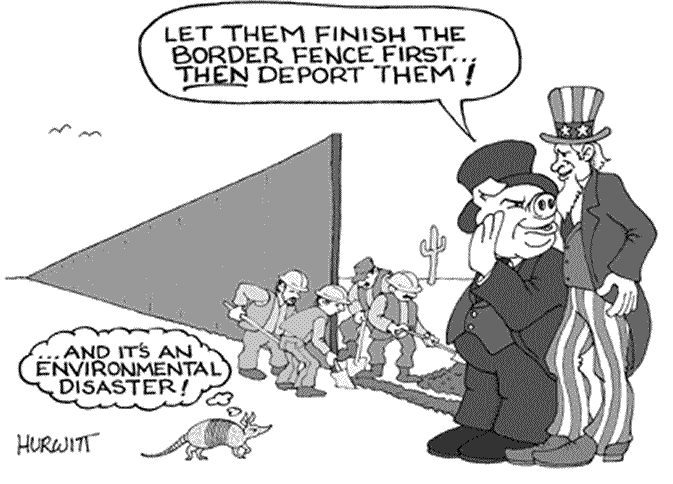
But it’s no less solid, no less insurmountable for those with the wrong passport, than any other wall that’s ever been built between people with economic resources and hands on the machinery of global power and those without. It’s no less environmentally catastrophic, interfering not only with human migration but with animal migration routes that are threatened with permanent disruption. It's no less symbolic of separation and exploitation, of our inability to live into the vision of Beloved Community offered to us by so many prophets over so many thousands of years. Our own home grown Separation Barrier is an ugly, rust colored reminder of our failure of imagination when it comes to our relationship with our neighbors to the South.
Walls across the world are remarkably, banally, similar. Walls that are built to divide are almost always built between populations “with” and populations “without.” Walls that are built to divide are never constructed by communities coming together—the only walls built in that way are shelter walls, walls of houses and community centers and places worship and education. Walls built to divide are built by governments, by corporations, by power brokers—not by grassroots communities. Not by love.
The Walls in Palestine and the U.S./Mexico Border have more in common than symbolism, though. Both are being built, in one way or another, by U.S. taxpayer dollars. The West Bank Wall is subsidized and made possible by the more than $3 billion in military aid that we pour into Israel each year, by loan guarantees and political support and UN vetoes offered without precondition. (The U.S. Army Corps of Engineers has recently begun constructing another massive Wall, this one on the border between the Gaza Strip and Egypt). There’s a direct corporate connection, as well. Elbit Systems, an Israeli company that produces surveillance and military equipment, is responsible for much of the detection equipment on the West Bank Wall and has half of the contract on the Border Wall.
Elbit, by the way, is one example of the way that people power continues to exert itself against the power of Walls. Elbit’s role in the Apartheid Wall in the West Bank has made it the target of international divestment campaigns. In response to a call from Palestinian civil society groups, human rights advocates around the world have spoken out—and acted out—against companies that profit from the ongoing conflict over and occupation of Palestinian land. The Palestinian Christian community has issued a Kairos call for churches around the world to join in these and efforts. Recently, a Norwegian government pension fund, a Danish bank, and a Danish pension fund have pulled millions of dollars in investments from Elbit because of the company's violations of international law and human rights. Divestment campaigns in the United States, including in many churches and college campuses, are targeting Elbit and creating alliances with groups working for the rights of migrants. Campaigns like these begin to expose the cracks in the seemingly monolithic Walls that divide us—cracks that we can get our fingers in, to steady us or to climb up or to pull down.
--
Walls, to me, have become so symbolic of what it is that we are struggling against, of the break down of the community we are called to, our inability to cross borders and barriers and find common ground.
What we are up against is separation—separation of so many kinds. The Dividing Walls of the world literally separate us from our neighbors, entrenching the divisions of economic or political apartheid. Our own personal struggles and alienation make us feel separated—from each other, from God’s infinite and incredible love for us.
Those of us who have taken the first stumbling steps in the prophetic walk toward justice and peace are up against separation, too. So often we get caught up in the narrow lanes of “issues” or “causes,” missing the Beloved Community created by our common struggle. There’s an organization called Jobs With Justice that asks supporters to take a pledge to show up, five times a year, for someone else’s struggle—for a cause or an issue that is not “my own.”
The only tool we have to dismantle the Walls that separate us is our collective imagination, that Spirit that invites us to create communities across dividing lines. It is exactly this collective imagination, unrestricted by borders, that we see in the Palestinian villages of Bil’in, Jayyous, and so many others, where Palestinian communities invite Israeli and international human rights defenders to join them in their nonviolent struggle against the Wall, and to take the message of justice back to their governments and to the corporations behind the construction of separation. It is this collective imagination that our OnFire group experienced when we spoke to Lupe Serrano at the Wall in Nogales, and he showed us the art that he and others have created on the Wall—something that is not allowed on the U.S. side—in a prophetic refusal to be contained. It is this collective imagination that we see as people of faith and hope join hands across borders and issues and identity groups, join hands and feet and voices in the great global uprising of people’s movements dedicated to justice, peace, and a more equitable sharing of the resources of this incredible world.
(Me with some of Lupe Serrano's art on the Wall in Nogales)
What we are up against is separation. But separation, as powerful as it is, is remarkably susceptible to the steady, patient work of the candle-lighters and the border-crossers and the Wall-defiers.
We can build very tall Walls and very long Walls and very deep Walls. The Wall that is being built on the border between the Gaza Strip and Egypt is deep enough to cut off tunnels that are the only means of commerce for the Palestinians in Gaza. The Wall that is being built on our southern border will supposedly be able to stop the wave of migration brought about by severe economic inequality. The Wall that the Israeli government builds in Palestine is supposed to be so high and so long that it will somehow be able to contain the anger of people who have been denied their freedom and their rights and their land.
But no matter how tall and how long and how deep we build these Walls, cracks begin to appear. Cracks that light can shine through. Cracks that voices can whisper through. Cracks that are big enough for our fingers, for our hands, for holding and for pulling and for climbing.
(A group of Palestinians from the village of Ni'lin pull down a section of the Wall on the 20th anniversary of the fall of the Berlin Wall in November. They are met with tear gas fired by the Israeli military)
Together, we will pull down these walls. And imagine, just imagine, what beautiful things we can build instead with the leftover reminders of our former separation.
David Hosey is a mission intern with Global Ministries of the United Methodist Church. From September 2007-December 2008 he worked with the Sabeel Ecumencial Liberation Theology Center, a Palestinian Christian organization based in Jerusalem. During that time he was blessed with the opportunity to meet, learn from, and walk alongside Palestinian Christians and Muslims, Israeli Jews, and international human rights defenders struggling for justice, peace, and reconciliation. He now lives in Washington, DC, where he serves as the National Media & Coalition Coordinator for the US Campaign to End the Israeli Occupation, a national coalition of more than 325 organizations working to change those U.S. policies toward Israel/Palestine that violate international law, human rights, and the principle of equality for all. He blogs (regularly) at the End the Occupation Blog and (more sporadically than he'd like) at City Of...
It’s a cold and rainy November morning. I’m up as usual at 6:30 a.m., out the door shortly after 8:00. Overnight, a wintry chill has moved in. Though I’m dressed warmly, my un-gloved hands are numb before I’m halfway to the Metro station. I can’t very well get to my pockets as I manage an umbrella in one hand and my lunch in the other—leftovers from last night’s dinner. On this near-icy day I’ll be able to enjoy a warm midday meal of spaghetti and meatballs—comfort food, in the psychological sense. Physically, I’ll be plenty comfortable at my desk in a heated office, sitting in a cushioned swivel chair with lumbar support. Comfort food for what discomfort?
At the same moment that I’m becoming conscious of my numbing fingertips, my eyes fall upon three figures in the distance. Two, like me, are huddled under umbrellas. The one in the center has his hands in the pocket of a hooded gray jacket and is shuffling back and forth in front of the Home Depot sign. Like me, these men are halfway to work; unlike me, they don’t know where they’re going, if anywhere. Their job “security” involves waiting in a parking lot, hoping that someone will need a hand with a home improvement project they’re tackling this Veterans’ Day.
As I continue on my way to the Metro, the parable of the laborers in the vineyard comes to mind for the hundredth time since moving to this Washington, D.C. neighborhood. How I long to be able to come home on a day like today and play the role of the compassionate owner—rewarding a full day’s wages to all of those seeking work. My head tells me that such charity is unsustainable, that what needs to be addressed and dismantled are the systems of injustice that allow this 2,000-year-old parable to have contemporary relevance. It is for that very reason that I’ve been so vocal in promoting immigration reform, health care reform, and an end to wage theft. But in this moment my righteous anger falls to the wayside. My heart breaks as I sense what can only be a small fraction of their vulnerability, a feeling that echoes an experience I had two weeks earlier in a completely different world.
2,500 miles from my northeast D.C. home lies the once-sleepy town of Altar, Mexico. The mass migration occurring over the past twenty-five years has brought a whirl of activity to the area. People from throughout Central America are passing through; some are on their first journey to the United States, but for many, the trek through the desert has become all too commonplace. During our visit* to Altar, I spent the night at a small migrant shelter run by a Catholic congregation. For no cost, sojourners can get a warm supper, a place to sleep and bathe, a change of clothes if need be, and a warm breakfast for up to three nights, though extensions are granted under extenuating circumstances.
Those seeking refuge at CCAMYN (Centre Comunitario de Atención al Migrante y Necesitado, or the Attention Center for Migrants and those in Need), however, are rarely first-time travelers. Most have already been deported from the United States—some multiple times over—and know about the shelter only because it’s not their first time traveling through the region. Migrants on their first journey are more likely to seek assistance from coyotes, guides who will see them at least part of the way to the border, but who are also likely to exploit, rob, or even physically harm the migrants—who often spend nearly all, if not everything, they have on the journey. In many cases, migrants cannot afford to pay the full price of a coyote, and must agree to pay off the debt for years to come, once they’ve crossed the border.
During dinner at CCAMYN, I found myself sitting next to Juan. He couldn’t have been that much older than I am, but the thousands of miles separating our birthplaces have taken their toll. I’ve spent the past five years on the move—mostly traveling to, from and within Europe—accessing countless destinations with the click of a mouse. Juan has spent the better part of the last ten years trying repeatedly to reach my place of departure. Temporary success has been his at least a dozen times, but that night he was on the road again. He has family in the States now, and they’re there “legally.” But he cannot risk seeing his own nieces out of fear that his sister might be charged with “harboring.” His hope is to cross and lay low for a few months; maybe then he can figure out a way to spend Christmas with the only family he has.
Juan was the first to push back from the large table where about thirty of us had eaten. The inches between us became miles again, as he embarked—under the cover of darkness—on a journey I’d have no trouble making in broad daylight two days later. Neither would I have any trouble boarding a plane to fly me back across the country to our nation’s capital.
Weeks have passed since I spent a night on CCAMYN’s tile floor. Back in the office, I heat up my leftovers and recline in my chair, watching the rain. I wonder where Juan is, whether the laborers have landed a job today, when the policymakers in the buildings outside my window will respond to the widespread, highly-organized advocacy efforts surrounding immigration reform. I wonder if members of my own family, congregation, and circle of friends will be ready to hear the stories of my trip to the border without writing me off for being “partisan,” or naïve to the “complexities” surrounding the situation. But what is so complicated about the desire of parents to feed their children, of young adults to seek a better life for themselves, of people of faith to advocate for those on the margins and in the shadows?
I put down my empty dish and sink answerless into my chair. It’s not as if these questions haven’t entered into the debate before, so what is to be done? I remember the feeling that rose in my chest as I observed the day laborers that morning: the horrific heartbreak, the longing for an outpouring of compassion, the urgency for justice to be realized on earth. But a glance at my inbox tells me that I’m not the only one experiencing this urgency. Articles, reports, action alerts, prayer requests, invitations to conference calls and prayer vigils—a whole movement is at my fingertips. I push back my plate, sit up, roll in my chair, and reach for the mouse, returning to the vineyard where new laborers are always welcome.
*In late October I traveled with a 10-member OnFire team to the US-Mexico border. We participated in a 3-day border justice immersion experience through the popular education organization BorderLinks. OnFire is a network of young adults within the Methodist Federation for Social Action, a national grassroots organization that promotes social justice in and beyond the United Methodist Church.


 “We have voices and power, and we are here to say we want this to be a fair and just system that treats people with dignity and respect,” said David Hosey, who attends Dumbarton UMC in Washington. He is a mission intern with the General Board of Global Ministries.
 Hames, who came here from Sierra Leone 20 years ago, endured her struggles with the inefficient, expensive immigration legal system before finally receiving her green card just this year.