Rock me mama anyway you feel
Hey mama rock me
Rock me mama like the wind and the rain
Rock me mama like a south-bound train
Hey mama rock me
-"Wagon Wheel," Bob Dylan; Old Crow Medicine Show
The border, la frontera, is death. Again and again when I was in Nogales I heard this expressed by people who call the border home, people whose existence is this increasingly militarized space. Again and again, I saw white crosses, x's that marked the spot, signifying the death in the desert along that line drawn in pencil by men far, far away.
There is a dusty fear here. As a member of the OnFireBorderlinks delegation in October 2009, we traveled from Tucson to Nogales to Altar and back. These memories hit me this week as I sat in front of a computer working at Faith in Public Life when I came across this article by Elliot Spagat from the Associated Press:
ALTAR, Sonora- Very few residents dare to drive on one of the roads out of this watering hole for migrants, fearing they will be stopped at gunpoint. They worry they will be told to turn around after their gas tanks are drained or, worse, be kidnapped or killed.
A shootout that left 21 people dead and six wounded on the road last week is the most gruesome sign that a relatively tranquil pocket of northern Mexico quickly is turning into a hotbed of drug-fueled violence on Arizona's doorstep...
Nogales, the main city in the region, which shares a border with the Arizona city of the same name, has had 131 murders so far this year, nearly surpassing 135 for all of 2009, according to a tally by the newspaper Diario de Sonora. That includes two heads found Thursday stuffed side-by-side between the bars of a cemetery fence.
The carnage still pales compared with other Mexican border cities, most notably Juarez, which lies across from El Paso, which had 2,600 murders last year. But the increase shows that some small cattle-grazing towns near Nogales are in the grip of drug traffickers who terrorize residents...
"If no one puts a stop to this, these will become ghost towns," said Jose Martin Mayoral, editor of Diario del Desierto, the newspaper in Caborca....
That phrase ghost towns echoes in my mind as I sit here, so far from this fear on the border yet still so affected by it. When I sat down to write this post, I thought about what it was like to sit in a van in Altar looking out into the desert at the road people took to get to the U.S.A. without documents. We couldn't get out of the van because the entrance to the road was patrolled by gangs. I wanted to write about NAFTA and the failed war on drugs, corruption and USAmerican citizens' own complicity with the violence that is migrating over this border in the way people are forced into drug and human trafficking. I wanted to compare the low levels of violent crime in USAmerican Border cities with the fact that Ciudad Juarez, just over the border from El Paso, Texas, is one of the most violent cities in the world.
Yet as I read this Associated Press article and think about what Altar and Nogales meant to me and why I am so saddened to read about the violence on the border, the image that keeps coming into my head is that of José, an eighteen year old who looked so much younger who came to the migrant shelter in Altar the night we were there. He was alone. I didn't get much of his story and don't know if any one of us did, but what I remember about José was the quiet way he sang along to the music as my friend David played guitar in the courtyard to the shelter. We sang song after song as the sun set and the coolness of the desert at night set in around us.
The sacred to me was in the movement of José's lips as we sang "Wagon Wheel" until the haunting beauty of the song dissipated in the darkness and we entered the shelter to eat.
As I continue to sit in front of a computer, I meditate on the movement of God in that moment and I just wish I could give it to you, the way the night air felt against my skin, the sound of Susanna's voice as she led us all in the song, the weight of it all. Would it change you, would it make you ask more questions, make you stop and think when you read about the increased violence of border cities on the Mexican side of the border?
"Wagon Wheel" is a song about traveling south, about getting to Raleigh to be with a lover, where if he died in Raleigh, he says "at least I will die free." I don't know if José ever made it north, but if he did, he only had a few months before SB1070 reminded the rest of us how undocumented people living in this country are not free, continuing to live in prisons of fear from a different violence. José reminds me why we need comprehensive immigration reform so badly, why I pray he is neither living in the border cities in Mexico nor in Arizona but that he has a chance to live free of that fear. That we all have the chance to live free of that fear.
"For Christ is our peace, who has made the two one and has destroyed the barrier, the dividing wall of hostility, by abolishing in Christ's flesh the law with its commandments and regulations. His purpose was to create one new person out of the two, thus making peace, and in this one body to reconcile both of them to God through the cross, by which he put to death their hostility. Christ came and preached peace to you who were far away and peace to those who were near. For through Christ we both have access to the Father by one Spirit." -- Ephesians 2: 14-18
I have a vendetta against walls.
For some reason, it has taken me months to write this. Sentences and phrases have been floating in my brain that whole time, surfacing occasionally to disturb the waters. Sometimes it takes an outside push, a rock dropped in the pond.
The other day a friend asked me, “What did you think when you went to Mexico and saw the Wall?” It wasn’t just a casual question. She knew that it wasn’t my first experience with a wall built to divide.
(Me at the Wall in Abu Dis) I lived in Jerusalem from September 2007-December 2008. If the early church considered Jerusalem to be the center of the world, I wonder what they would think of the city today, divided as it is by a massive concrete wall, some 25 feet high, studded with watchtowers and barbed wire and defiant graffiti, broken in places by checkpoints that serve as choke points on the movement and access of Palestinian civilians. In urban areas, the wall is twice as high as the Berlin Wall, and its total length stretches four times as long. Its route snakes deep in the West Bank, Palestinian territory occupied by Israel since 1967. More than 75% of its projected route is inside the West Bank, rather than on the internationally recognized border between Israel and the hoped-for Palestinian state.
(The Wall at Qalandia Checkpoint, between Jerusalem and Ramallah)
(A map of the route of the Wall in the West Bank)
The Wall divides not only Israelis from Palestinians—a problematic enough separation if there is ever to be peace in the land that is called Holy—but Palestinians from Palestinians. In the East Jerusalem neighborhood of Abu Dis, close to where I lived, it runs right up the center of the street, cutting Palestinians off from family, work places, places of worship, schools, and clinics that used to be just across the way. In villages like Bil'in, Jayyous, and Ni'lin, it cuts Palestinian farmers off from land and water resources that they have had access to for hundreds of years. A July 9, 2004 advisory ruling from the International Court of Justice declared the route of the Wall to be illegal under international humanitarian and human rights law. Palestinian communities, with the solidarity of Israeli and international human rights defenders, have worked and marched and demonstrated and struggled against the construction of the Wall. 19 Palestinians have been killed by the Israeli army during protests against the Wall. The youngest of these, Ahmed Husan Youssef Mousa, was only 10 years old. Hundreds more protestors, Israelis, Palestinians, and internationals, have been wounded. One U.S. citizen, Tristan Anderson, was shot in the face with a high velocity tear gas canister and remains hospitalized with brain damage almost a year later. If he had been Palestinian, he likely would have died—prevented from reaching necessary care because of restrictions on Palestinian movement.
(Unarmed protesters against the Wall in the village of Bil'in are violently dispersed by the Israeli military. Photo by ActiveStills, an Israeli organization)
So when our OnFire/BorderLinks group got to the border crossing in Nogales, and got our first sight of the U.S./Mexico Border Wall, it seemed an oddly familiar sight. Nogales used to be one community, straddling the border between Mexico and the United States. Now it is cut in two—separated, divided by that ugly wall.
(Photos of the Wall in Nogales, Sonora, Mexico. The crosses memorialize those who have died making the border crossing)
It sounds strange to say, but compared to the massive Apartheid Wall in Jerusalem (the Hebrew word for the wall, “Hafrada,” means separation—just like the term “Apartheid” in Afrikaans) the U.S./Mexico border wall looks a bit…dinky. Constructed largely out of scrap metal from the United States’ first foray into invading Iraq, the Wall left me with the impression that, given enough momentum, enough people, we could just push it down.
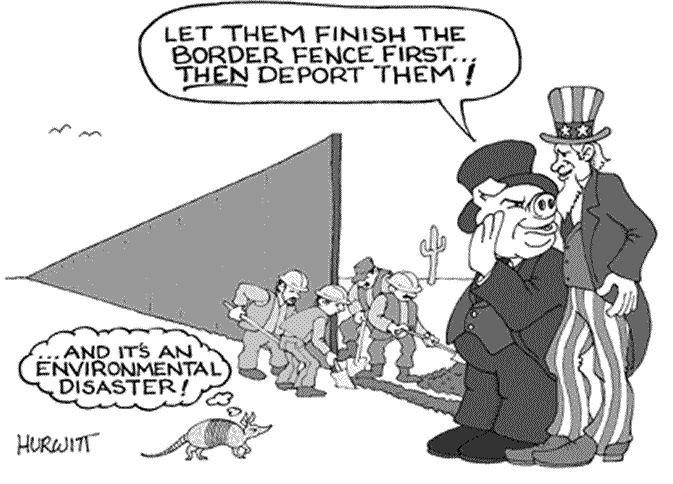
But it’s no less solid, no less insurmountable for those with the wrong passport, than any other wall that’s ever been built between people with economic resources and hands on the machinery of global power and those without. It’s no less environmentally catastrophic, interfering not only with human migration but with animal migration routes that are threatened with permanent disruption. It's no less symbolic of separation and exploitation, of our inability to live into the vision of Beloved Community offered to us by so many prophets over so many thousands of years. Our own home grown Separation Barrier is an ugly, rust colored reminder of our failure of imagination when it comes to our relationship with our neighbors to the South.
Walls across the world are remarkably, banally, similar. Walls that are built to divide are almost always built between populations “with” and populations “without.” Walls that are built to divide are never constructed by communities coming together—the only walls built in that way are shelter walls, walls of houses and community centers and places worship and education. Walls built to divide are built by governments, by corporations, by power brokers—not by grassroots communities. Not by love.
The Walls in Palestine and the U.S./Mexico Border have more in common than symbolism, though. Both are being built, in one way or another, by U.S. taxpayer dollars. The West Bank Wall is subsidized and made possible by the more than $3 billion in military aid that we pour into Israel each year, by loan guarantees and political support and UN vetoes offered without precondition. (The U.S. Army Corps of Engineers has recently begun constructing another massive Wall, this one on the border between the Gaza Strip and Egypt). There’s a direct corporate connection, as well. Elbit Systems, an Israeli company that produces surveillance and military equipment, is responsible for much of the detection equipment on the West Bank Wall and has half of the contract on the Border Wall.
Elbit, by the way, is one example of the way that people power continues to exert itself against the power of Walls. Elbit’s role in the Apartheid Wall in the West Bank has made it the target of international divestment campaigns. In response to a call from Palestinian civil society groups, human rights advocates around the world have spoken out—and acted out—against companies that profit from the ongoing conflict over and occupation of Palestinian land. The Palestinian Christian community has issued a Kairos call for churches around the world to join in these and efforts. Recently, a Norwegian government pension fund, a Danish bank, and a Danish pension fund have pulled millions of dollars in investments from Elbit because of the company's violations of international law and human rights. Divestment campaigns in the United States, including in many churches and college campuses, are targeting Elbit and creating alliances with groups working for the rights of migrants. Campaigns like these begin to expose the cracks in the seemingly monolithic Walls that divide us—cracks that we can get our fingers in, to steady us or to climb up or to pull down.
--
Walls, to me, have become so symbolic of what it is that we are struggling against, of the break down of the community we are called to, our inability to cross borders and barriers and find common ground.
What we are up against is separation—separation of so many kinds. The Dividing Walls of the world literally separate us from our neighbors, entrenching the divisions of economic or political apartheid. Our own personal struggles and alienation make us feel separated—from each other, from God’s infinite and incredible love for us.
Those of us who have taken the first stumbling steps in the prophetic walk toward justice and peace are up against separation, too. So often we get caught up in the narrow lanes of “issues” or “causes,” missing the Beloved Community created by our common struggle. There’s an organization called Jobs With Justice that asks supporters to take a pledge to show up, five times a year, for someone else’s struggle—for a cause or an issue that is not “my own.”
The only tool we have to dismantle the Walls that separate us is our collective imagination, that Spirit that invites us to create communities across dividing lines. It is exactly this collective imagination, unrestricted by borders, that we see in the Palestinian villages of Bil’in, Jayyous, and so many others, where Palestinian communities invite Israeli and international human rights defenders to join them in their nonviolent struggle against the Wall, and to take the message of justice back to their governments and to the corporations behind the construction of separation. It is this collective imagination that our OnFire group experienced when we spoke to Lupe Serrano at the Wall in Nogales, and he showed us the art that he and others have created on the Wall—something that is not allowed on the U.S. side—in a prophetic refusal to be contained. It is this collective imagination that we see as people of faith and hope join hands across borders and issues and identity groups, join hands and feet and voices in the great global uprising of people’s movements dedicated to justice, peace, and a more equitable sharing of the resources of this incredible world.
(Me with some of Lupe Serrano's art on the Wall in Nogales)
What we are up against is separation. But separation, as powerful as it is, is remarkably susceptible to the steady, patient work of the candle-lighters and the border-crossers and the Wall-defiers.
We can build very tall Walls and very long Walls and very deep Walls. The Wall that is being built on the border between the Gaza Strip and Egypt is deep enough to cut off tunnels that are the only means of commerce for the Palestinians in Gaza. The Wall that is being built on our southern border will supposedly be able to stop the wave of migration brought about by severe economic inequality. The Wall that the Israeli government builds in Palestine is supposed to be so high and so long that it will somehow be able to contain the anger of people who have been denied their freedom and their rights and their land.
But no matter how tall and how long and how deep we build these Walls, cracks begin to appear. Cracks that light can shine through. Cracks that voices can whisper through. Cracks that are big enough for our fingers, for our hands, for holding and for pulling and for climbing.
(A group of Palestinians from the village of Ni'lin pull down a section of the Wall on the 20th anniversary of the fall of the Berlin Wall in November. They are met with tear gas fired by the Israeli military)
Together, we will pull down these walls. And imagine, just imagine, what beautiful things we can build instead with the leftover reminders of our former separation.
David Hosey is a mission intern with Global Ministries of the United Methodist Church. From September 2007-December 2008 he worked with the Sabeel Ecumencial Liberation Theology Center, a Palestinian Christian organization based in Jerusalem. During that time he was blessed with the opportunity to meet, learn from, and walk alongside Palestinian Christians and Muslims, Israeli Jews, and international human rights defenders struggling for justice, peace, and reconciliation. He now lives in Washington, DC, where he serves as the National Media & Coalition Coordinator for the US Campaign to End the Israeli Occupation, a national coalition of more than 325 organizations working to change those U.S. policies toward Israel/Palestine that violate international law, human rights, and the principle of equality for all. He blogs (regularly) at the End the Occupation Blog and (more sporadically than he'd like) at City Of...
Greetings OnFire members! I’m writing today to inform you of an exciting opportunity to travel to the US-Mexico border for a short immersion trip from October 28-31st. We will be working with BorderLinks for an educational and interactive experience at the border: learning, sharing and serving to bring about positive social transformation in the areas of migration and immigration.
We will meet in Phoenix and drive to the BorderLinks facility in Tuscon, AZ, on Wednesday, October 28th. BorderLinks will prepare an itinerary for us that will include activities such as visiting and serving at aid stations, hearing from persons working to document human rights abuses, visiting with immigrants and their families, learning about labor practices in factories along the border, advocacy training in migrant rights.
The cost of the programming including lodging and food is $200, plus the cost of travel to and from Phoenix. [OnFire will provide transportation from Phoenix to Tuscon, where BorderLinks is located.] This includes a $100 scholarship from the Methodist Federation for Social Action. We will gladly help interested young people with fund raising ideas.
We would like to have a committed group of 10-13 people attend this event. The trip is open to any and all young adults who are interested in connecting their faith to issues of immigration and border justice. If you’re interested, please contact Jennifer Mihok at jennifer.mihok@gmail.com for more information and registration materials.
Here’s a bit more information about BorderLinks:
BorderLinks is an international leader in experiential education that raises awareness and inspires action around global political economics. BorderLinks grew out of the Sanctuary Movement in the 1980’s when faith communities, universities, and other organizations rallied to advocate on behalf of thousands of refugees fleeing persecution in Central America. Today, BorderLinks’ educational programs focus on issues of immigration, community formation, development, and social justice in the borderlands between Mexico, the U.S and beyond. As a bi-national organization, BorderLinks brings people together to build bridges of solidarity across North and Latin American borders and promote intercultural understanding and respect. For more information, visit www.borderlinks.org.